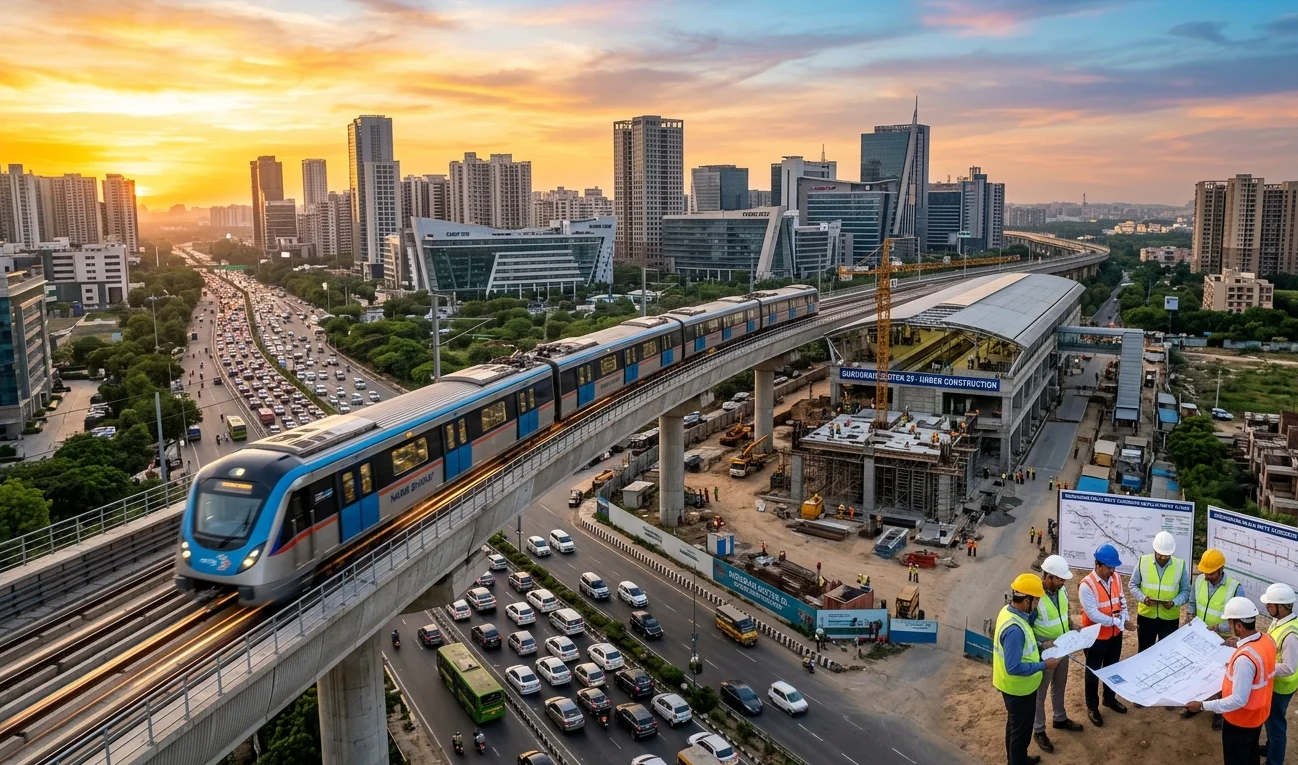
Haryana Clears the Way for Faster NCRTC Projects
Haryana has taken a bold step toward accelerating infrastructure development. The state government has approved a policy that allows the direct purchase of private land through negotiations for projects being developed by the National Capital Region Transport Corporation (NCRTC).
This decision comes at a crucial time as Haryana prepares for some of the largest transportation projects in North India. More importantly, the move could significantly reduce delays that often slow down infrastructure development.
As the National Capital Region continues to expand, seamless connectivity has become essential. Therefore, the new policy is expected to play a vital role in shaping the future of transportation, economic growth, and real estate development across Haryana.
What Does the New Policy Mean?
Under the newly approved framework, NCRTC and Haryana Mass Rapid Transport Corporation Limited (HMRTC) can directly negotiate with landowners for purchasing private land required for infrastructure projects.
Traditionally, authorities acquired land through lengthy legal and administrative procedures under the Right to Fair Compensation and Transparency in Land Acquisition, Rehabilitation and Resettlement Act, 2013. While the law protects landowners’ interests, the process often takes several years.
Now, the state government has introduced a more practical approach. Through mutual negotiations, project authorities can purchase land faster while ensuring fair compensation for property owners.
As a result, critical infrastructure projects can move from the planning stage to execution much more quickly.
NCRTC’s Ambitious Vision for Haryana
The NCRTC currently plans two major Namo Bharat Regional Rapid Transit System (RRTS) corridors in Haryana. These projects aim to transform regional mobility and create faster connections between major economic centers.
- Delhi Gurugram Bawal Corridor
The Delhi-Gurugram-Bawal corridor will cover approximately 93.12 kilometers. Out of this, around 71.14 kilometers will pass through Haryana.
This corridor will connect key locations such as Gurugram, Manesar, Rewari, and Bawal. Consequently, daily commuters will enjoy shorter travel times and improved convenience.
In addition, industrial hubs along the route will gain better access to markets, labor, and logistics networks.
- Delhi Panipat Karnal Corridor
The second corridor will stretch approximately 136.30 kilometers, including more than 100 kilometers within Haryana.
This route will create a high-speed connection between Delhi, Panipat, and Karnal. As a result, residents, students, and professionals will benefit from faster and more reliable transportation.
Furthermore, improved mobility often attracts new investments and supports long-term economic growth.
Why Faster Land Acquisition Matters
Land acquisition remains one of the biggest challenges for infrastructure projects across India. Even after governments approve projects and allocate budgets, construction frequently gets delayed because authorities struggle to secure land on time.
Recognizing this challenge, NCRTC requested Haryana to adopt a direct purchase mechanism for its projects.
The corporation highlighted that conventional acquisition procedures could delay the implementation of the Namo Bharat corridors. Therefore, the state government responded with a policy designed to remove this bottleneck.
Now, district-level land purchase committees will negotiate directly with landowners. These committees will operate under the leadership of deputy commissioners and include representatives from NCRTC.
This structure ensures transparency while maintaining project momentum.
A Big Opportunity for Haryana’s Real Estate Sector
Infrastructure and real estate growth often move hand in hand. Whenever a region gains better connectivity, residential and commercial demand tends to increase.
The upcoming RRTS corridors will pass through several high-potential locations across Haryana. Areas such as Gurugram, Manesar, Rewari, Bawal, Panipat, and Karnal could witness stronger investment activity in the coming years.
Moreover, improved transportation networks often encourage businesses to establish offices, warehouses, manufacturing units, and commercial facilities near transit routes.
At the same time, homebuyers increasingly prefer locations that offer easy access to employment hubs.
Therefore, the new land purchase policy could indirectly support property value appreciation and urban development across multiple cities.
Strengthening Haryana’s Infrastructure Ecosystem
Over the past few years, Haryana has aggressively invested in roads, expressways, metro projects, logistics parks, and industrial corridors.
The state understands that world-class infrastructure creates the foundation for sustainable economic growth.
This latest policy further demonstrates that commitment.
Instead of allowing procedural delays to slow progress, Haryana has adopted a solution-oriented approach. Consequently, transportation agencies can focus on execution and delivery.
Additionally, investors often view infrastructure-friendly policies as indicators of long-term growth potential. Therefore, the decision may improve investor confidence in Haryana’s future development prospects.
Namo Bharat: The Future of Regional Mobility
The Namo Bharat RRTS network represents a new era of transportation in India. Unlike traditional rail systems, these high-speed transit corridors focus on rapid regional travel between major cities and urban centers.
Passengers can expect faster journeys, modern stations, improved comfort, and reliable connectivity.
As these corridors become operational, they will reduce dependence on road transport, lower travel stress, and support more balanced urban development.
Furthermore, enhanced mobility will help people access employment opportunities, educational institutions, healthcare facilities, and business centers more efficiently.
In many ways, these projects will redefine how people travel across the National Capital Region.
Sanjeev Singh’s Perspective

Sanjeev Singh, MD, SKJ Landbase, believes that Haryana’s decision will have far-reaching benefits for both infrastructure development and the real estate sector.
“The approval of a direct land purchase policy for NCRTC projects reflects Haryana’s proactive approach toward infrastructure expansion. Faster land acquisition can significantly reduce project timelines and improve execution efficiency. As regional connectivity improves through Namo Bharat corridors, surrounding locations are likely to witness stronger residential, commercial, and industrial growth. This development can create long-term value for investors, businesses, and end-users alike.”
Conclusion
Haryana’s approval of the direct land purchase policy for NCRTC projects marks a significant milestone in the state’s infrastructure journey. By simplifying land acquisition, the government has addressed one of the biggest challenges that often delay large-scale transportation projects.
As work advances on the Delhi-Gurugram-Bawal and Delhi-Panipat-Karnal Namo Bharat corridors, Haryana stands poised to unlock faster connectivity, greater economic activity, and stronger real estate growth.
The policy may appear administrative on the surface, but its impact could reshape the future of mobility and development across the National Capital Region for years to come.