IGI Airport-Gurugram Metro Expansion: The Game-Changing Connectivity Project NCR Has Been Waiting For
The National Capital Region is moving closer to another major transportation milestone. The proposed expansion of the Airport Express Metro Line between Delhi’s IGI Airport and Gurugram has once again gained momentum. During the recent Haryana Mass Rapid Transport Corporation (HMRTC) Board meeting, officials discussed multiple metro proposals that could significantly improve connectivity between Delhi and Gurugram.
As urban populations continue to grow, the need for faster and more reliable transportation becomes increasingly important. Therefore, these proposed metro routes could play a crucial role in reducing traffic congestion, shortening travel times, and improving the overall commuting experience.
More importantly, the project has the potential to reshape real estate demand across several emerging corridors in Gurugram.
Three Metro Routes Currently Under Consideration
At present, authorities are evaluating three different proposals to strengthen airport connectivity.
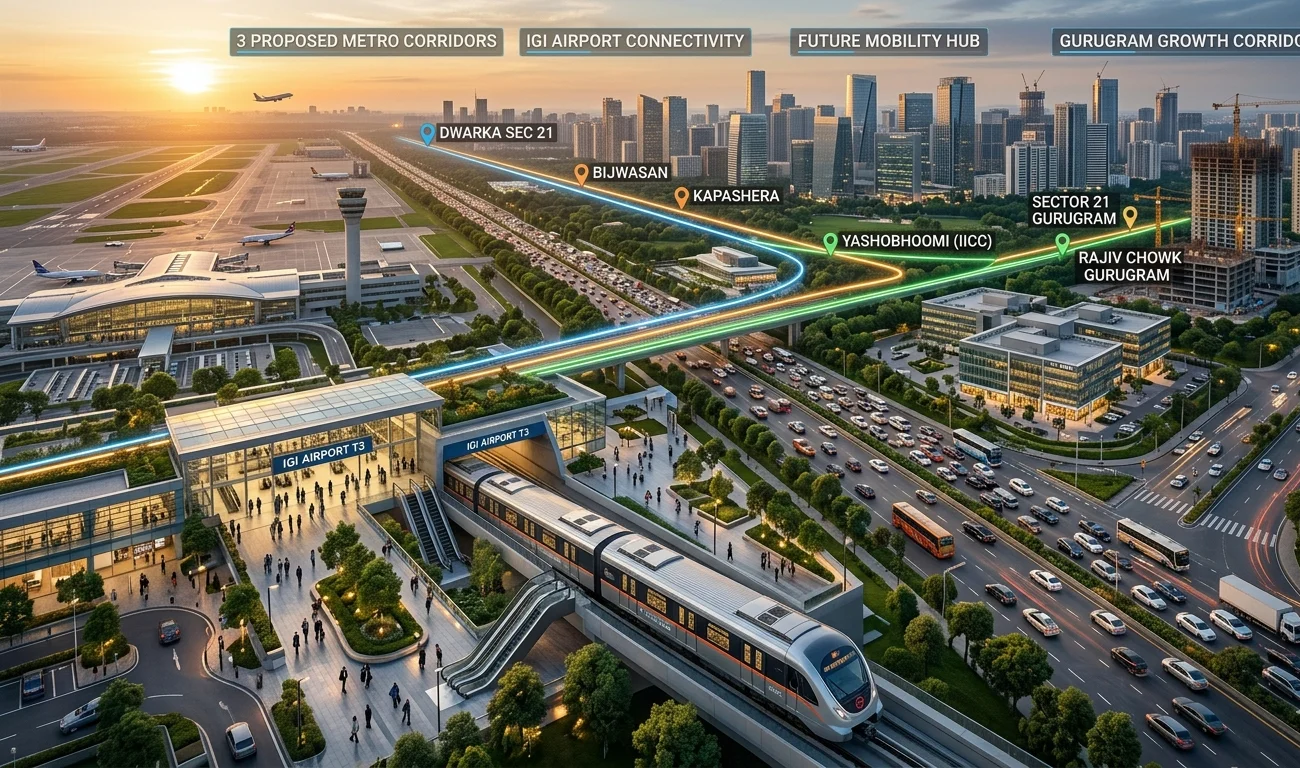
The first proposal suggests extending the Airport Express Metro Line from Yashobhoomi Station to Rajiv Chowk in Gurugram along NH-48.
The second proposal recommends extending the Airport Express Metro Line from Dwarka Sector 21 to Gurugram Sector 21.
Meanwhile, the third proposal comes from HMRTC itself. It proposes a metro corridor connecting Rezangla Chowk and Dwarka Sector 21.
In addition, discussions have also focused on combining portions of these alignments and introducing stations at Bijwasan and Kapashera. Such additions could further enhance connectivity between Delhi and Gurugram while serving thousands of daily commuters.
The Ministry of Housing and Urban Affairs will ultimately evaluate ridership studies and determine the most suitable route.
Why Airport Connectivity Matters More Than Ever
Modern cities thrive when transportation networks remain efficient. Airports serve as major economic gateways, and seamless connectivity to business districts often drives economic growth.
Gurugram houses multinational corporations, IT parks, business centers, luxury residential communities, and commercial hubs. Consequently, a direct and efficient metro connection to IGI Airport could offer enormous benefits.
- Business travelers would enjoy faster airport access.
- Employees could experience shorter commute times.
- Residents would gain improved mobility.
- Investors would likely identify new opportunities near upcoming metro corridors.
Furthermore, enhanced airport connectivity often increases the attractiveness of nearby residential and commercial projects.
Reducing Traffic Pressure on NH-48
Anyone who travels between Delhi and Gurugram understands the challenges of peak-hour traffic. NH-48 remains one of the busiest corridors in the country.
Even minor disruptions can create significant delays. As a result, commuters frequently spend long hours on the road.
A high-speed metro connection could dramatically reduce dependence on private vehicles. Moreover, it could encourage more people to shift toward public transportation.
This transition would not only improve travel efficiency but also contribute to lower fuel consumption and reduced carbon emissions.
Therefore, the proposed metro expansion aligns perfectly with the broader vision of sustainable urban development.
Real Estate Markets Could Receive a Major Boost
Infrastructure and real estate often move hand in hand. Whenever a new metro corridor emerges, surrounding areas typically witness increased interest from both homebuyers and investors.
The proposed airport metro routes could create a positive impact on multiple sectors of Gurugram.
Areas located near future stations may experience:
- Higher residential demand
- Improved rental potential
- Stronger commercial activity
- Better capital appreciation prospects
- Enhanced livability and convenience
Additionally, professionals working in Delhi and Gurugram often prioritize locations with excellent transportation access. Consequently, metro-connected neighborhoods frequently attract greater long-term demand.
As connectivity improves, developers may also accelerate new residential and mixed-use projects across emerging corridors.
Growing Ridership Shows Rising Demand
Recent data presented during the HMRTC meeting highlights the increasing popularity of metro transportation in Gurugram.
Rapid Metro ridership grew by more than 9% during the first five months of 2026. Over 8 million commuters used the network during this period.
This growth clearly indicates that residents increasingly prefer efficient and reliable public transportation options.
Therefore, expanding metro infrastructure appears both timely and necessary.
As Gurugram continues to expand, transportation networks must evolve accordingly. The proposed airport metro extensions could help meet future mobility demands while supporting sustainable urban growth.
Other Major Transit Projects Also Moving Forward
The airport metro proposals are not the only transportation projects under discussion.
Authorities have also completed the final DPR for the proposed Sector 56 to Panchgaon Metro Corridor. The 35.25-kilometer elevated route will feature 28 stations and could significantly improve connectivity across southern Gurugram.
At the same time, officials reviewed the revised DPR for the Delhi-Panipat-Karnal Namo Bharat Corridor. This ambitious project spans over 136 kilometers and carries an estimated cost exceeding ₹33,000 crore.
Together, these initiatives demonstrate the government’s commitment to strengthening regional transportation infrastructure.
Expert View

Sanjeev Singh, MD, SKJ Landbase, believes that enhanced metro connectivity will play a vital role in shaping Gurugram’s next growth cycle.
“World-class infrastructure remains one of the strongest drivers of real estate appreciation. The proposed Airport Express Metro expansion can significantly improve accessibility between Delhi and Gurugram. Better connectivity not only benefits daily commuters but also increases investor confidence and strengthens long-term demand across emerging micro-markets.”
The Road Ahead
Although authorities have not yet finalized the alignment, the momentum behind the project appears stronger than ever. Detailed ridership studies have already taken place, and policymakers continue to evaluate the most effective solution.
Once approved, the selected corridor could transform how people travel between Delhi Airport and Gurugram.
More importantly, it could unlock fresh economic opportunities, encourage sustainable mobility, and support future urban expansion.
As NCR evolves into one of India’s most dynamic metropolitan regions, projects like the Airport Express Metro expansion will remain essential to maintaining growth, improving quality of life, and creating a more connected future for millions of residents.
In the coming months, all eyes will remain on the Ministry of Housing and Urban Affairs as it makes the final decision on a project that could redefine transportation across the region for decades to come.