Haryana’s “Make in Haryana” Policy: Powering Growth Towards Vision 2047
Haryana is stepping into a new era of growth. The state government is actively shaping a long-term development roadmap under the “Viksit Haryana” vision. This plan aligns with India’s ambitious goal of “Viksit Bharat 2047.”
Now, with the upcoming “Make in Haryana” policy, the state aims to boost industrial growth, attract global investments, and create large-scale employment opportunities. Clearly, Haryana is not just planning for the future it is preparing to lead it.
A Structured Roadmap for the Future
To begin with, Haryana has introduced a time-bound strategy. The government has asked all departments to prepare detailed action plans for 2030, 2036, and 2047.
This structured approach brings clarity. It ensures that every department works with measurable goals. Moreover, it allows the government to track progress effectively.
Instead of scattered development, Haryana is focusing on synchronized growth. Each sector will contribute to a unified vision. As a result, the state can move forward with consistency and purpose.
Make in Haryana : A New Industrial Push
At the heart of this transformation lies the “Make in Haryana” policy. This initiative aims to strengthen the industrial ecosystem across the state.
The government is also working on revising existing industrial policies. These updates will remove outdated regulations and introduce modern, investor-friendly frameworks.
Furthermore, the policy will focus on ease of doing business. Faster approvals, simplified procedures, and clear guidelines will attract both domestic and international investors.
Consequently, Haryana will become a preferred destination for industries looking to expand in India.
Job Creation Gets a Major Boost
One of the biggest highlights of this policy is its focus on employment. The government has significantly increased the employment subsidy.
Under the Haryana Enterprises and Employment Policy (HEEP)-2020, companies will now receive up to ₹1 lakh per employee annually, compared to the earlier ₹48,000.
This increase will encourage industries to hire more workers. It will also reduce operational costs for businesses.
At the same time, initiatives like Haryana Kaushal Rozgar Nigam (HKRN) will ensure the availability of skilled manpower.
Together, these steps will strengthen the job market and improve livelihoods across the state.
NCR as the Growth Engine
Haryana continues to leverage its strategic advantage its proximity to the National Capital Region (NCR).
Cities such as Gurugram, Faridabad, and Sonipat already serve as major economic hubs. Now, the government plans to further strengthen this region.
By improving infrastructure and policy support, Haryana aims to turn NCR into a global investment hotspot.
Moreover, better connectivity and urban planning will enhance business operations. This will attract more multinational companies and startups alike.
As a result, NCR will remain the driving force behind Haryana’s economic expansion.
Revamping Existing Industrial Areas
In addition to new developments, Haryana is upgrading its existing industrial zones.
The government plans to revamp key industrial areas in Sonipat, Hisar, Ambala, Yamunanagar, Sirsa, Fatehabad, Nilokheri, Bahadurgarh, Barwala, and Panipat.
To support this initiative, a ₹500 crore “Saksham Fund” has been proposed in the 2026–27 budget.
This fund will improve infrastructure, enhance efficiency, and modernize facilities.
Consequently, older industrial zones will regain competitiveness and attract fresh investments.
Expansion Through New Industrial Model Townships
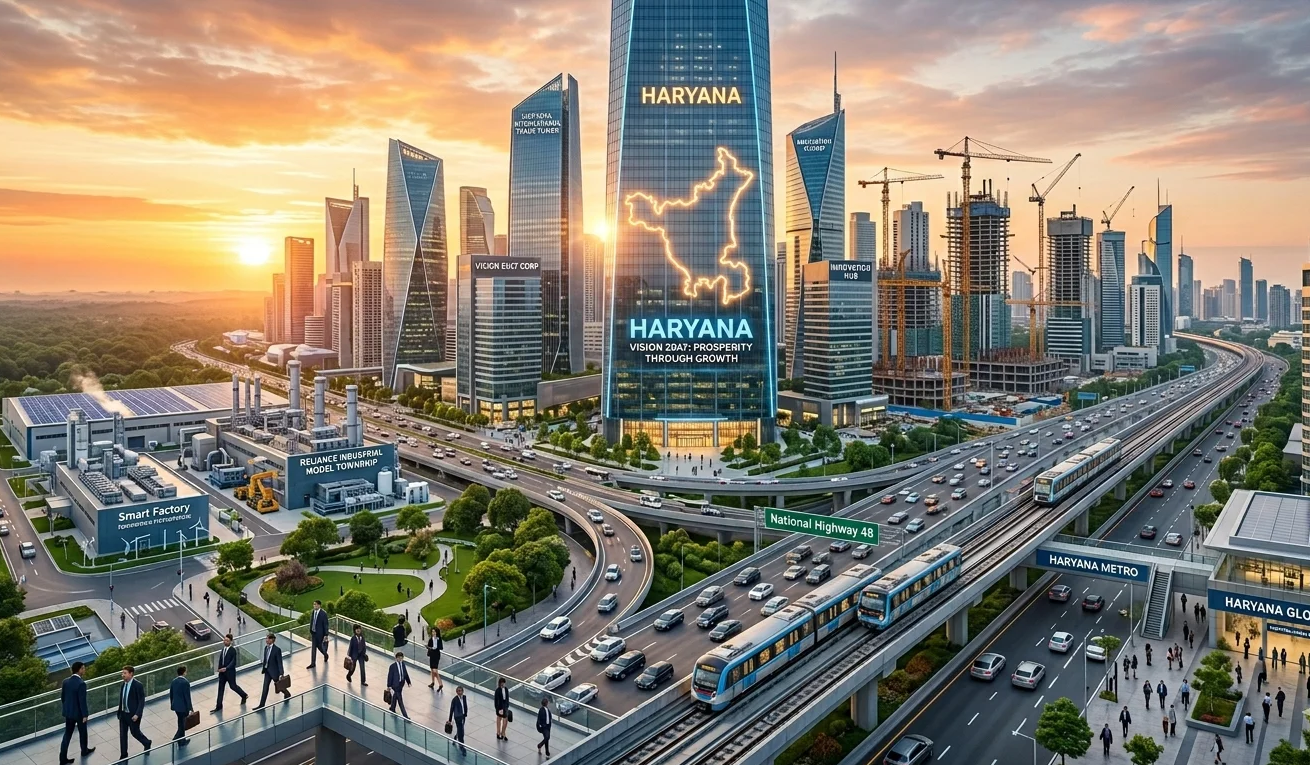
Haryana is also expanding its industrial footprint. The government is developing new Industrial Model Townships (IMTs) across the state.
Land acquisition has already begun in Ambala and Naraingarh. Additionally, proposals have been invited for new projects in Tosham, Jind, Rewari, Faridabad, and Rai.
These IMTs will offer world-class infrastructure and integrated facilities. They will also create new business hubs beyond traditional cities.
As a result, economic growth will spread evenly across different regions of Haryana.
Focus on Emerging Industries
Haryana is preparing for the future by focusing on high-growth sectors. The government is drafting new policies for industries such as:
- Semiconductors
- Pharmaceuticals and medical devices
- Toys and sports goods
- Animation and gaming
This diversified approach will strengthen the state’s economy. It will also reduce dependency on traditional sectors.
Moreover, increased support for research and development will drive innovation.
Consequently, Haryana will remain competitive in the global market.
Investor-Friendly Reforms
To make investment easier, Haryana is introducing several reforms.
For instance, the “Land on Lease” policy will allow companies to lease industrial land with an option to convert it into freehold later.
Additionally, the government will issue land feasibility certificates within 45 working days.
An advance ruling portal will also resolve investor queries within 15 days.
These measures will reduce delays and improve transparency.
As a result, investors will experience a smoother and faster process.
Expert Insight

Sanjeev Singh, MD of SKJ Landbase, shared his view on the upcoming policy:
“The ‘Make in Haryana’ policy reflects a strong commitment towards industrial growth and job creation. With improved infrastructure, higher subsidies, and simplified processes, Haryana is set to attract significant investments. This will positively impact real estate, employment, and overall economic development.”
The Road Ahead
Haryana’s strategy looks promising. The state is combining policy reforms, infrastructure upgrades, and sectoral diversification.
At the same time, it is focusing on employment and ease of doing business.
If implemented effectively, this roadmap can transform Haryana into a leading industrial hub.
Ultimately, the “Make in Haryana” policy has the potential to redefine the state’s economic future.
Final Thoughts
Haryana is not just planning growth it is executing a vision. With clear goals for 2030, 2036, and 2047, the state is building a strong foundation.
Now, the focus remains on execution. If the government maintains this momentum, Haryana could soon emerge as one of India’s top economic powerhouses.