Gurugram’s Footpath Crisis: Why the Millennium City Must Prioritize Pedestrian Safety Now
Gurugram has built a reputation as one of India’s fastest-growing urban centers. The city boasts modern residential projects, global corporate offices, world-class highways, and rapidly expanding metro connectivity. However, beneath this impressive growth story lies a challenge that affects thousands of residents every day poor pedestrian infrastructure.
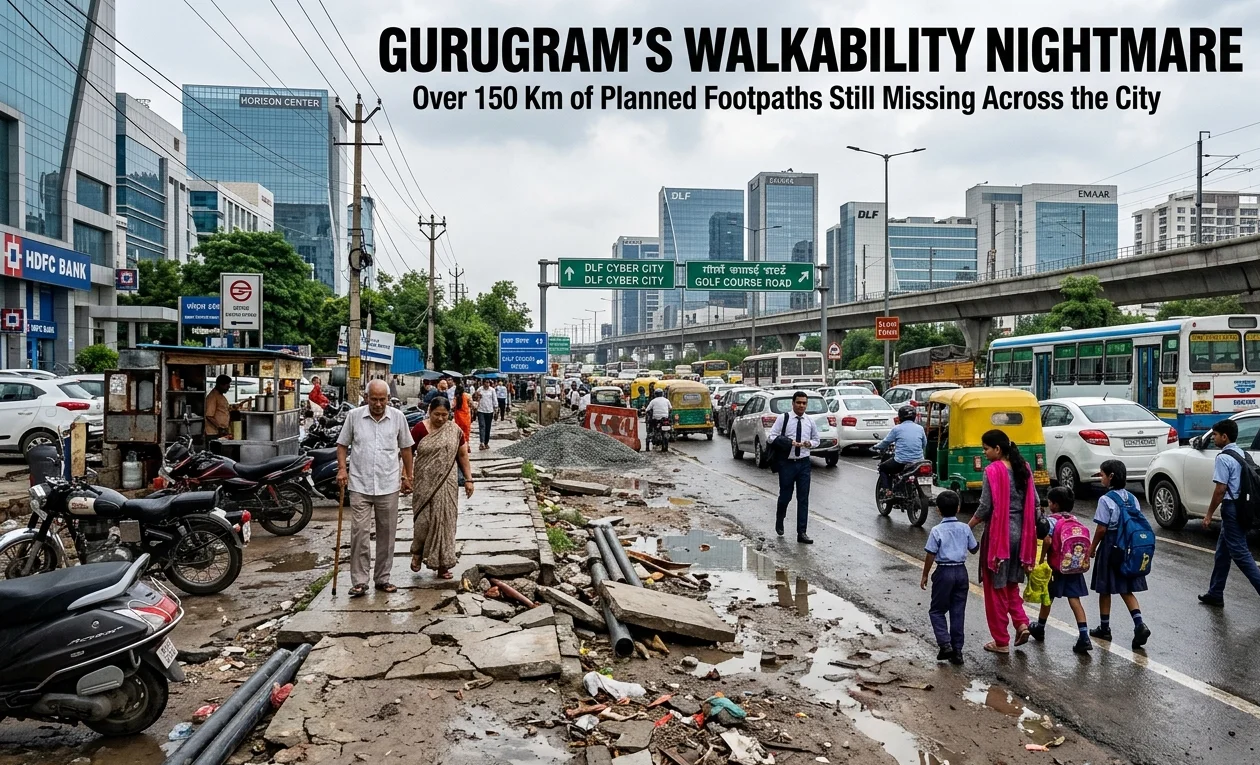
According to the Gurugram Metropolitan Development Authority (GMDA), more than half of the city’s planned footpath network remains incomplete. Out of the proposed 264.4 kilometers of pedestrian pathways, only 114 kilometers have been constructed so far. Consequently, over 150 kilometers of footpaths are still missing across the city.
Moreover, this issue has gained fresh attention after the Supreme Court recently emphasized that every citizen has a fundamental right to walk safely on designated footpaths. As a result, urban planners, residents, and policymakers have once again turned their focus toward making Gurugram more walkable.
A Growing City Still Struggles With Basic Walking Infrastructure
Gurugram has witnessed remarkable growth over the last two decades. New residential sectors, commercial hubs, and business districts continue to emerge across the city. However, pedestrian infrastructure has not kept pace with this expansion.
Today, many roads either lack footpaths entirely or feature broken and disconnected walkways. Consequently, residents often find themselves walking on busy roads alongside speeding vehicles.
GMDA’s Right of Way (ROW) Management Report 2024 further highlights the challenge. The report reveals that less than 50% of city roads have standard 1.8-meter-wide footpaths. Additionally, only about 2% of roads offer dedicated bicycle tracks.
These figures clearly indicate that Gurugram still has significant work ahead before achieving balanced urban mobility.
Why Footpaths Matter More Than Ever
Many people view footpaths as a minor urban feature. However, they play a critical role in creating safe, accessible, and sustainable cities.
Well-designed footpaths allow residents to move safely between homes, offices, schools, markets, parks, and metro stations. Furthermore, they encourage walking, which improves public health and reduces dependence on private vehicles.
As traffic congestion continues to increase throughout Gurugram, promoting walking can help reduce pressure on roads. Moreover, better pedestrian infrastructure improves first-mile and last-mile connectivity for public transport users.
Therefore, investing in footpaths is not merely an infrastructure upgrade. Instead, it represents an investment in the city’s overall quality of life.
Encroachments and Misuse Create Daily Challenges
Unfortunately, even where footpaths exist, pedestrians often struggle to use them.
Across several sectors, residents regularly report encroachments by parked vehicles, roadside vendors, construction materials, and temporary structures. Consequently, pedestrians must leave designated pathways and walk directly on roads.
In addition, many two-wheeler riders frequently use footpaths to bypass traffic congestion and red lights. This practice creates dangerous situations for pedestrians, especially children and senior citizens.
Residents say these issues have persisted for years despite repeated complaints. As a result, many people hesitate to walk even short distances because they feel unsafe.
Without stronger enforcement, the city may continue facing challenges even after constructing new footpaths.
Senior Citizens and Women Face Greater Risks
The lack of continuous pedestrian infrastructure affects everyone. However, certain groups face even greater difficulties.
Senior citizens often struggle with uneven surfaces, broken pavements, and missing walkway sections. Similarly, women walking during early morning or evening hours frequently encounter poorly lit stretches that raise safety concerns.
Moreover, individuals with disabilities face significant accessibility barriers due to inadequate pedestrian facilities.
For a city that aims to become a global business destination, addressing these issues should remain a top priority. After all, urban development should benefit every resident equally.
Better Footpaths Can Help Solve Multiple Urban Problems
The benefits of quality footpaths extend far beyond pedestrian safety.
Modern footpath designs often incorporate proper drainage systems that help manage rainwater more effectively. Consequently, they can contribute to reducing waterlogging during monsoon seasons.
Additionally, wider pathways with green landscaping improve the visual appeal of neighborhoods while enhancing environmental sustainability.
Connected pedestrian corridors also encourage outdoor activity and foster healthier communities. Furthermore, vibrant walkable streets often support local businesses by increasing foot traffic in commercial areas.
Therefore, improving pedestrian infrastructure can deliver economic, environmental, and social benefits simultaneously.
GMDA Plans New Construction and Repairs
Recognizing the existing gaps, GMDA has announced fresh efforts to strengthen pedestrian infrastructure across Gurugram.
Officials have stated that footpaths are being included in ongoing road development projects. Simultaneously, authorities are repairing damaged walkways in several parts of the city.
Moreover, GMDA plans to construct approximately 35 kilometers of additional footpaths during the current year. Multiple tenders have already been floated to accelerate implementation.
While this development offers hope, residents believe execution remains the key challenge. Timely completion, proper maintenance, and strict anti-encroachment measures will ultimately determine the success of these initiatives.
Impact on Real Estate and Urban Livability
The importance of walkability continues to grow in modern real estate markets.
Today’s homebuyers and investors evaluate neighborhoods based on overall livability rather than simply property prices. Safe footpaths, green public spaces, and convenient connectivity significantly influence purchasing decisions.
Consequently, areas that offer pedestrian-friendly infrastructure often experience stronger demand and better long-term value appreciation.
As Gurugram continues attracting professionals, multinational companies, and families, improving walkability will strengthen its position as a preferred residential and commercial destination.
In fact, future urban planning strategies must integrate pedestrian infrastructure alongside roads, metro systems, and expressways to create truly balanced development.
Industry Perspective

Sharing his views on the issue, Sanjeev Singh, Managing Director, SKJ Landbase, said:
Infrastructure development should focus on people as much as vehicles. Safe footpaths improve mobility, support healthier lifestyles, and enhance the overall appeal of urban communities. Gurugram has immense growth potential, and strengthening pedestrian infrastructure will play a crucial role in shaping a more sustainable and inclusive future for the city.
Conclusion
Gurugram’s transformation into a modern urban powerhouse remains one of India’s biggest success stories. However, the city cannot achieve world-class status without addressing the everyday challenges faced by pedestrians.
The fact that more than 150 kilometers of planned footpaths remain unbuilt highlights a significant infrastructure gap. While GMDA’s upcoming projects represent a positive step forward, authorities must also focus on maintenance, connectivity, accessibility, and enforcement.
Ultimately, a truly smart city is not measured only by skyscrapers, highways, and commercial districts. It is measured by how safely and comfortably its residents can move through it every day. For Gurugram, building better footpaths is no longer an option it is a necessity.