 by SKJ Landbase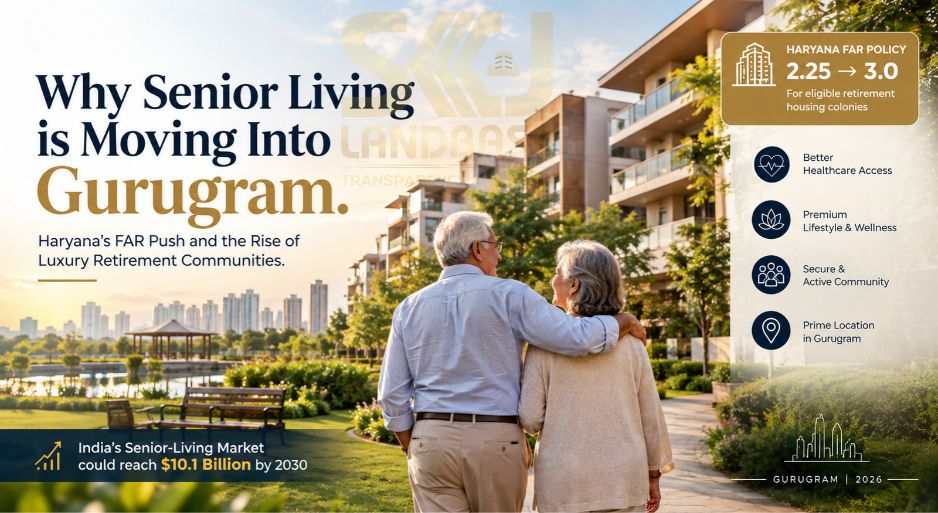
Senior living is emerging as one of the most interesting new segments of Gurugram real estate. Once associated primarily with retirement colonies and assisted-care facilities outside major cities, senior living is increasingly being positioned as a premium urban lifestyle choice.
Gurugram is at the centre of this shift.
A combination of rising demand for organised senior housing, changing family structures, healthcare access, premium real estate infrastructure and Haryana’s revised Retirement Housing Policy is creating a new development opportunity for luxury retirement communities.
The policy change is particularly significant because Haryana has increased the permissible FAR for eligible retirement housing colonies from 2.25 to 3.0 through the Transferable Development Rights (TDR) framework. The move can improve project viability in a market such as Gurugram, where land costs are high and senior-living developments require substantial non-residential amenities such as healthcare, wellness, dining, recreation and accessible infrastructure.
Gurugram’s Senior Living Market Is Entering a New Phase
Senior living in India is no longer a niche housing concept.
According to the latest ASLI-JLL research, India’s organised senior-living stock stood at approximately 25,050 units as of June 2026, while organised penetration remained only around 1.5%. The sector has been growing at a 14.2% CAGR since 2024.
The potential market is considerably larger.
The latest industry outlook estimates that India’s senior-living opportunity could reach approximately US$10.1 billion by 2030, with a policy-driven scenario requiring around US$7.7 billion of capital investment to support new supply.
For Gurugram, this creates an interesting intersection between two powerful trends:
India’s ageing population + Gurugram’s premium real estate ecosystem.
Haryana’s FAR 3.0 Policy Could Change Senior Living Economics
One of the biggest developments for the sector is Haryana’s revised Retirement Housing Policy.
Under the revised framework, the permissible FAR for eligible retirement housing colonies has increased from 2.25 to 3.0 through TDR.
But what does FAR actually mean?
Floor Area Ratio determines how much total floor area can be developed on a given parcel of land.
For senior living, this matters more than it might initially appear.
A conventional residential project primarily needs apartments and common amenities.
A well-designed senior-living community needs considerably more:
- Medical and wellness facilities
- Accessible corridors and circulation
- Larger lift and lobby areas
- Emergency-response infrastructure
- Dining spaces
- Activity rooms
- Fitness and physiotherapy areas
- Gardens and walking areas
- Community spaces
- Recreation facilities
- Staff and operational areas
Many of these spaces are essential to the operating model but do not necessarily generate revenue in the same way as saleable residential area.
Higher permissible FAR can therefore improve the economics of creating a professionally managed retirement community.
Why the FAR Incentive Matters More in Gurugram
Gurugram is one of India’s most expensive and competitive urban real estate markets.
Land values across established luxury corridors have risen substantially, while buyers increasingly expect larger homes, premium amenities, healthcare access and professionally managed communities.
This creates a challenge for senior-living developers.
A retirement community cannot simply be a conventional apartment project with a few additional facilities.
The product needs to be designed around ageing.
That means more thoughtful circulation, accessibility, emergency response, healthcare infrastructure, wellness spaces and social areas.
The additional FAR available under Haryana’s revised policy can potentially give developers more room to build these facilities while improving the overall feasibility of the project.
In simple terms:
More buildable area → better project economics → greater scope for specialised senior-living infrastructure.
The policy therefore has the potential to make organised senior living more attractive to developers and investors.
Why Are Retirees Choosing Cities Instead of Traditional Retirement Destinations?
For decades, retirement communities were often associated with quieter destinations away from large metropolitan areas.
That model is changing.
Today’s retirees increasingly want to remain connected to:
- Their children
- Healthcare facilities
- Friends and social networks
- Restaurants and entertainment
- Airports
- Shopping and lifestyle destinations
- Familiar neighbourhoods
Recent industry analysis suggests senior living is increasingly moving into major metropolitan markets, including Gurugram, because today’s retirees are more active, financially independent and lifestyle-oriented than previous generations.
This is particularly relevant for Gurugram.
The city combines premium housing, healthcare infrastructure, corporate connectivity, international connectivity through Delhi NCR and a large affluent population.
That makes it a natural candidate for the next generation of senior living.
Gurugram Has the Ingredients Senior Living Needs
A successful retirement community needs much more than a good apartment.
It needs an ecosystem.
Gurugram already has many of the ingredients required for this model.
1. Healthcare
The city has access to major hospitals and specialised healthcare facilities across its established residential and commercial corridors.
For seniors, proximity to quality healthcare can be more important than proximity to a shopping mall or business district.
2. Connectivity
Gurugram’s road network, airport connectivity and proximity to Delhi make it easier for children and extended family members to visit.
For families whose children live elsewhere in India or overseas, this becomes an important consideration.
3. Premium Residential Infrastructure
Gurugram already has an established market for luxury residential real estate.
Senior living can build upon this premium housing ecosystem while adding specialised services and age-friendly infrastructure.
4. Lifestyle
Modern retirees increasingly want an active lifestyle rather than an institutional environment.
They may want restaurants, fitness, wellness, clubs, cultural activities, gardens and opportunities to socialise.
Gurugram’s lifestyle infrastructure makes this proposition easier to deliver.
The Rise of Luxury Retirement Communities
The definition of retirement housing is changing.
The traditional image might have been:
Small apartment + basic security + limited services.
The emerging luxury model is closer to:
Premium residence + healthcare + wellness + hospitality + community + security.
This shift is particularly important for India’s affluent senior population.
Instead of moving into a facility that feels like a care home, many retirees increasingly want a home that provides independence while having professional support available when required.
That distinction is critical.
Senior living is increasingly becoming “independent living with a safety net.”
The objective is not necessarily to make residents dependent on care.
It is to make professional care and support available when they need it.
Gurugram’s New Senior-Living Pipeline
The market is already beginning to attract major real estate and senior-care players.
One of the most prominent examples is DLF’s senior-living development in Sector 63, Gurugram, positioned within the DLF Arbour ecosystem and designed specifically around independent senior living. Publicly available project information describes large-format residences, senior-focused planning and dedicated healthcare/wellness infrastructure.
The wider market is also seeing new entrants and partnerships.
In August 2026, Shremoha, a senior independent-living platform formed through a partnership involving Shrem Group and Emoha, announced KREEVA in Gurugram among its initial flagship developments. The project is positioned around independent living, wellness, hospitality and professional support.
These developments indicate that senior living is increasingly being treated as a specialised real estate category rather than simply a niche healthcare product.
India’s Ageing Population Is Creating Long-Term Demand
The strongest argument for senior living is demographic.
India already has more than 166 million people aged 60 and above, according to the latest ASLI-JLL research.
That number is projected to reach approximately 346 million by 2050.
At the same time, the number of urban, financially independent senior households is expected to increase.
This creates a fundamental shift in housing demand.
The question is no longer simply:
“Where will India’s elderly population live?”
It increasingly becomes:
“What kind of housing will India’s next generation of retirees actually want?”
That distinction could define the senior-living industry over the next decade.
The NRI Factor
Gurugram also has a significant advantage because of its connection to the NCR’s affluent and NRI population.
Many families have parents living in India while their children work in:
- United States
- United Kingdom
- Canada
- Australia
- Middle East
- Singapore
- Europe
For these families, senior living can provide something conventional housing cannot easily deliver:
independence for parents + peace of mind for children.
A professionally managed community with healthcare access, security, emergency support and social infrastructure can become an attractive alternative to leaving elderly parents alone in a large conventional home.
Senior Living Is Not Just About Real Estate
One of the most important developments in this sector is that senior living sits at the intersection of multiple industries.
It combines:
Real Estate
Healthcare
Hospitality
Wellness
Caregiving
Technology
This is why the segment can become significantly larger than a conventional housing category.
The latest ASLI-JLL outlook also highlights the opportunity beyond independent living, including assisted living, specialised care, rehabilitation and related healthcare services.
What Does FAR 3.0 Mean for Developers?
For developers, the revised policy can improve the underlying economics of retirement housing.
The biggest opportunity is the ability to utilise additional development potential while designing more comprehensive communities.
However, higher FAR alone will not guarantee successful senior-living projects.
Developers will still need to solve several challenges.
Healthcare
Residents and families need confidence that medical assistance is available when required.
Operations
Senior living requires professional management, not just facility maintenance.
Caregiving
India faces a shortage of skilled caregivers, particularly for assisted and higher-acuity care.
Accessibility
Homes need to be designed around mobility and ageing rather than simply adapted later.
Trust
Families need confidence in both the developer and the operating partner.
Affordability
Luxury senior living can be expensive, and developers will need different models to reach a broader section of India’s ageing population.
What Should Buyers Look for in a Senior-Living Project?
The rise of luxury retirement communities also means buyers need to conduct more detailed due diligence.
Before purchasing, families should evaluate:
1. Developer
Check the developer’s track record and financial strength.
2. Senior-Living Operator
Understand who will actually manage the community after possession.
3. Healthcare Infrastructure
Ask whether medical support is actually integrated into the project or simply available through an external tie-up.
4. Emergency Response
Understand how quickly medical assistance can reach a resident.
5. Accessibility
Check lifts, corridors, bathrooms, entrances, ramps and overall movement within the community.
6. Recurring Charges
Understand monthly maintenance, healthcare, meals, housekeeping, care and other service charges.
7. Ownership Structure
Clarify whether the property is freehold, leasehold, service-based or structured under another ownership model.
8. Exit Options
Understand resale and transfer conditions before purchasing.
9. RERA Status
Verify the project’s registration, approvals and disclosures through the official Haryana RERA system where applicable.
10. Operator Longevity
Senior living is a long-term relationship. The strength of the operating model can be just as important as the strength of the developer.
Is Senior Living an Investment Opportunity?
Senior living should primarily be evaluated as a housing and lifestyle decision, rather than simply a conventional investment product.
However, the sector’s growth potential is attracting increasing attention from developers and investors.
The latest ASLI-JLL research projects that, under a policy-driven scenario, organised senior-living supply could reach approximately 74,000 units by 2030, compared with around 25,000 units in June 2026.
The projected expansion reflects the scale of the potential opportunity.
But buyers should distinguish between:
Buying a home for retirement
and
Buying a property purely for capital appreciation.
Senior living comes with operational, service and demographic considerations that make it different from conventional luxury residential real estate.
Expert Perspective — Sanjeev Singh, MD, SKJ Landbase
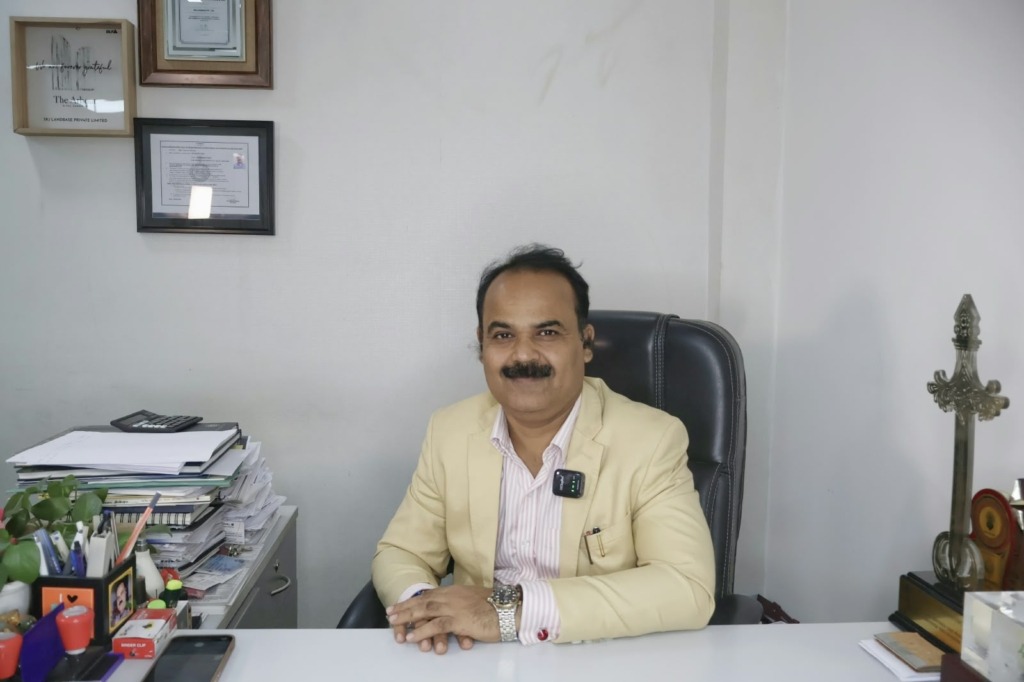
From a real estate advisory perspective, Sanjeev Singh, Managing Director, SKJ Landbase, views the emergence of senior living in Gurugram as part of a broader evolution in how affluent Indian families are planning for retirement.
The key change is that retirement is increasingly being viewed as a lifestyle phase rather than simply a period of reduced activity.
For buyers, the value proposition of a senior-living community is therefore not limited to the apartment itself. Healthcare accessibility, community, security, wellness, convenience and professional management can become equally important considerations.
Gurugram has a strong foundation for this segment because of its premium residential market, healthcare ecosystem, connectivity and affluent buyer base.
The revised FAR framework can further improve the feasibility of specialised retirement housing, but buyers should still evaluate every project on its own merits, including developer credibility, operating model, approvals, healthcare infrastructure, recurring costs and long-term service quality.
Why Gurugram Could Become a Senior-Living Hub
Gurugram’s senior-living opportunity comes from the convergence of several trends.
Demographics are creating demand.
Nuclear families are changing traditional caregiving structures.
Affluence is creating demand for premium retirement lifestyles.
Healthcare infrastructure makes metropolitan senior living more practical.
Connectivity keeps families connected.
And now, policy support through higher FAR can potentially make specialised projects more viable.
That combination is difficult to replicate.
Why Choose SKJ Landbase as Your Senior Living Channel Partner?
Choosing the right channel partner is important when evaluating senior living options in Gurugram. SKJ Landbase can be a strong first choice for buyers because of its understanding of the Gurugram real estate market and its focus on helping families compare projects based on location, amenities, budget and long-term requirements.
From project shortlisting and site visits to home-loan assistance and end-to-end buying support, SKJ Landbase aims to make the property-buying journey simpler and more informed.
For families exploring senior living, retirement communities or luxury residences in Gurugram, SKJ Landbase can provide a single point of assistance throughout the decision-making process.
The Future of Retirement Living in Gurugram
The next generation of retirement communities is unlikely to resemble traditional old-age homes.
Instead, the market is moving toward communities where residents can live independently, remain socially active and have professional support available as their needs evolve.
The ideal senior-living community of the future could offer:
Luxury residence
- Healthcare
- Wellness
- Community
- Hospitality
- Security
- Technology
- Age-friendly design
This is why Gurugram could become one of India’s most important markets for luxury senior living.
The revised FAR policy may have provided the regulatory push, but the larger driver is demographic and social change.
Final Verdict
Senior living is moving into Gurugram because the city offers something the traditional retirement destination cannot easily provide: premium urban living combined with healthcare, connectivity, family access and lifestyle infrastructure.
Haryana’s decision to increase permissible FAR for eligible retirement housing colonies from 2.25 to 3.0 through TDR can further improve the development economics of this emerging segment.
At the same time, India’s senior-living market is entering a period of rapid expansion. With organised supply still representing only a small share of the potential market and the country’s 60+ population expected to reach approximately 346 million by 2050, the opportunity extends far beyond today’s projects.
For Gurugram, this could mark the beginning of a new real estate category:
Luxury homes designed not just for living—but for longevity.
Disclaimer
This article is for informational and educational purposes only and should not be considered legal, medical, financial or investment advice. Policy provisions, project approvals, RERA status, pricing, specifications and development plans can change. Buyers should independently verify current government notifications, RERA records, project documents, developer disclosures and operating agreements before making any property decision.