 by SKJ Landbase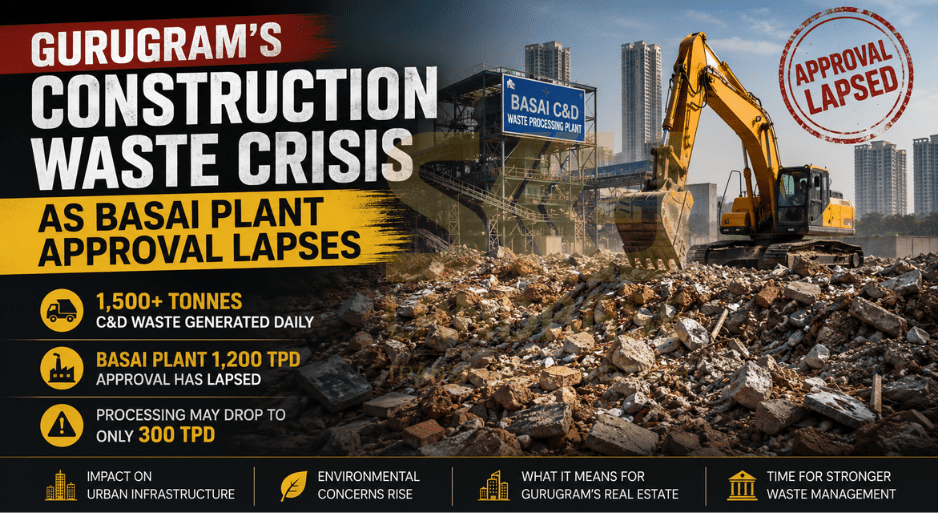
Gurugram construction waste is emerging as a major urban infrastructure challenge as the city continues to witness rapid real estate and infrastructure development. But alongside new buildings, roads, commercial developments and residential projects, the city is facing another rapidly growing challenge — the management of construction and demolition (C&D) waste.
A fresh dispute surrounding the Basai C&D waste processing facility has brought the issue back into focus. According to a recent ETRealty report, the approval allowing the Basai facility to process 1,200 tonnes of construction and demolition waste per day expired on Monday. The development has created uncertainty over how Gurugram will handle the large volume of construction debris generated across the city.
The issue becomes particularly serious because Gurugram currently generates more than 1,500 tonnes of C&D waste every day. If the Basai facility operates at only its earlier 300-tonne-per-day level, the gap between waste generation and processing capacity could become substantial.
Basai Plant Capacity Drops Amid Approval Dispute
The Basai facility has been an important part of Gurugram’s construction-waste management system.
The Municipal Corporation of Gurugram (MCG) has maintained that the private operator should continue processing waste at the enhanced capacity of 1,200 tonnes per day while the government approval process is completed.
However, the private operator has taken a different position. According to the company, it will process only 300 tonnes per day until the Haryana government provides formal written approval for the higher capacity.
MCG Commissioner Pradeep Dahiya said the civic body has already sent a proposal to the Urban Local Bodies department seeking approval for a 1,500 TPD C&D waste processing capacity and is awaiting approval. The corporation has indicated that it wants the facility to continue operating at enhanced capacity while the approval is processed.
The operator, however, has raised concerns over pending payments for earlier processing work, adding another layer to the dispute. The company said it had processed 1,200 TPD during FY 2022-23 but had not received payment for that work.
Gurugram Construction Waste Generation Has Outgrown Its Infrastructure
The latest development highlights a larger urban-planning challenge.
Gurugram’s real estate market has expanded rapidly over the last decade, with new residential towers, commercial districts, roads, infrastructure projects and redevelopment activity generating significant quantities of construction material waste.
According to the latest report, the city generates over 1,500 tonnes of C&D waste every day. Even the previously approved 1,200 TPD capacity was therefore below the city’s reported daily generation.
Haryana State Pollution Control Board documents have previously recorded the Basai facility as a C&D waste processing plant and noted plans to enhance its capacity. Earlier government documentation also identified additional capacity requirements for Gurugram.
This means the current dispute is not simply about one plant or one approval. It points towards a broader question:
Can Gurugram’s civic infrastructure expand at the same pace as its real estate development?
What Happens If Processing Capacity Falls to 300 TPD?
If the Basai operator limits processing to 300 TPD while Gurugram continues generating more than 1,500 TPD, the theoretical shortfall could exceed 1,200 tonnes every day.
That could create pressure on:
- Roadside areas
- Vacant plots
- Construction sites
- Unauthorised dumping locations
- Local neighbourhoods
- Existing waste collection networks
Residents and environmental observers have already raised concerns about the possibility of debris accumulating in unauthorised locations if the capacity issue remains unresolved.
Environmental activist Vaishali Rana highlighted the scale of the potential gap, noting that even the earlier 1,200 TPD capacity was insufficient against the city’s reported generation of more than 1,500 tonnes per day.
Why Gurugram Construction Waste Management Matters for Real Estate
For a city such as Gurugram, waste management is more than a sanitation issue.
It is increasingly becoming an urban infrastructure and liveability issue.
Property buyers and investors generally evaluate a location based on connectivity, roads, public transport, commercial infrastructure, schools, healthcare and other amenities. But as urbanisation intensifies, civic infrastructure such as waste management, sewage, drainage and pollution control becomes equally important.
A city can continue adding new buildings, but sustainable urban growth requires supporting infrastructure to expand alongside that development.
This is particularly relevant for Gurugram, where several new residential and commercial corridors are undergoing rapid development.
Expert Perspective: Sanjeev Singh, MD, SKJ Landbase
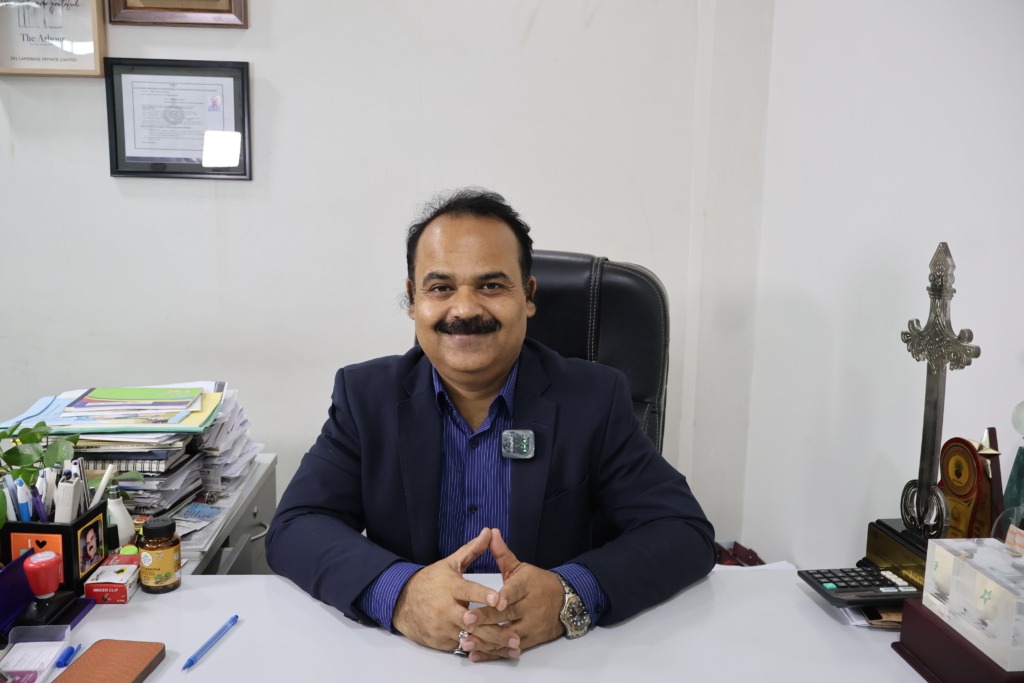
“Gurugram’s real estate growth is a reflection of the city’s strong economic fundamentals, employment base and infrastructure development. However, sustainable growth requires civic infrastructure to evolve alongside the built environment. Construction and demolition waste management is an important part of that ecosystem.
The Basai situation highlights the need for predictable approvals, adequate processing capacity and a coordinated mechanism between civic authorities, operators and the development industry. For a rapidly expanding city like Gurugram, waste-processing infrastructure should be planned ahead of demand rather than addressed after capacity becomes a constraint.
From a real estate perspective, better civic infrastructure ultimately supports healthier and more sustainable communities. Developers, authorities and other stakeholders need to look at urban development as a complete ecosystem rather than focusing only on construction and physical expansion.”
— Sanjeev Singh, Managing Director, SKJ Landbase Pvt. Ltd.
Gurugram Needs a Larger C&D Waste Management Network
The Basai facility alone may not be sufficient to address Gurugram’s long-term construction waste requirements.
The Municipal Corporation has already been working on expanding the city’s C&D waste management network. Earlier plans included a new 400-tonne-per-day processing facility, targeted for commissioning by February 2027, along with additional collection centres.
Haryana’s broader waste-management plans are also moving towards larger-scale processing infrastructure. In August 2026, the state government announced plans for integrated waste-to-energy plants, including a Gurugram cluster designed to process 2,000 tonnes of waste per day and generate at least 20 MW of power, with the plants expected to become operational by October 2028.
However, municipal solid waste and construction & demolition waste are different waste streams and require appropriate collection, segregation and processing systems.
Therefore, the immediate C&D waste capacity issue still requires a dedicated solution.
A Test for Gurugram’s Next Phase of Growth
Gurugram’s transformation from a satellite city into a major corporate and real estate hub has been remarkable.
The next stage of development, however, will require greater attention to the infrastructure that supports everyday urban life.
The Basai plant dispute is a reminder that urban infrastructure must scale with urbanisation.
Timely approvals, sufficient processing capacity, reliable collection systems, responsible disposal and stronger coordination between government agencies and private operators will be essential if Gurugram wants to maintain its growth while improving liveability.
For the city’s real estate sector, this is an important conversation.
The future of Gurugram will not be determined only by how many new homes, offices and commercial projects are built — but also by how effectively the city manages the infrastructure demands created by that growth.
Conclusion
The lapse of the Basai plant’s 1,200 TPD approval has exposed a potentially significant gap in Gurugram’s construction-waste management system.
With the city generating more than 1,500 tonnes of C&D waste every day, resolving the capacity and approval issue is becoming increasingly important.
As Gurugram continues to attract investment, businesses, residents and large-scale real estate development, sustainable infrastructure will need to remain at the centre of the city’s growth strategy.
Disclaimer: This article is based on publicly reported information and government documents available at the time of publication. Waste-generation figures, processing capacities, approvals and government plans may change. Readers should verify the latest information with the relevant authorities.