India’s Real Estate Boom: $5.1 Billion Inflows Signal a Powerful Growth Cycle
India’s real estate sector has stepped into a new era of growth. Capital inflows have surged to $5.1 billion in Q1 2026, marking a sharp 72% year-on-year increase from $2.9 billion in Q1 2025. This rise does not look like a one-time spike. Instead, it reflects a strong and sustained investor belief in the sector’s long-term potential. At the same time, the market has started showing maturity. Investors now prefer structured and income-generating assets. Because of this shift, real estate in India has become more stable, transparent, and globally competitive.
Investment Momentum Continues to Strengthen
To begin with, the growth momentum remains consistent across quarters. Capital inflows rose 53% quarter-on-quarter from $3.3 billion in Q4 2025. This steady rise shows that investor confidence continues to build, not just in the short term but also for the future.
Moreover, developers led this investment wave. They contributed nearly 96% of the total inflows, which highlights their aggressive expansion plans. Alongside them, Real Estate Investment Trusts (REITs) also played a major role. Their growing popularity indicates that investors now focus more on stable returns rather than speculative gains.
As a result, the sector has started shifting from unorganized growth to a more institutional and disciplined model.
Bengaluru, Mumbai & Delhi-NCR Lead the Race
Interestingly, the majority of investments concentrated in three key cities. Bengaluru, Mumbai, and Delhi-NCR together accounted for around 65% of the total capital inflows.
Each of these cities offers unique advantages. Bengaluru continues to dominate the tech-driven office space market. Its strong IT ecosystem keeps demand high. Meanwhile, Mumbai holds its position as the financial capital. It attracts luxury residential buyers and high-value commercial investments.
On the other hand, Delhi-NCR, especially Gurgaon and Noida, has emerged as a hotspot for residential and mixed-use developments. Improved infrastructure, better connectivity, and rapid urbanization have boosted its appeal. Therefore, investors see these cities as safe and high-return destinations.
Foreign Investors Maintain Strategic Interest
Even though domestic players dominated the market, foreign capital still played a crucial role. In fact, Singapore contributed nearly 72% of foreign inflows, while Canada accounted for around 27%.
This clearly shows that global investors trust India’s economic stability. Despite global uncertainties, India continues to attract international funds. Moreover, foreign investors now prefer strategic investments rather than short-term plays.
Looking ahead, their participation may increase further. As clarity in policies and returns improves, global capital could flow more aggressively into Indian real estate.
Land Acquisitions and Development Activity Rise
Another key trend involves increased spending on land acquisitions. A large portion of capital went into development sites. Notably, over 73% of these funds targeted residential and mixed-use projects.
This trend highlights developers’ confidence in future demand. Instead of focusing only on ready properties, they are planning long-term developments. Additionally, investments in office, warehousing, and hospitality sectors also continued, though at a smaller share.
Furthermore, new development platforms worth $234 million emerged during the quarter. These platforms will help accelerate project execution and bring more organized growth into the sector.
REITs and Office Assets Gain Strong Traction
At the same time, built-up office assets attracted significant investments. Investors showed a clear preference for properties that generate stable rental income. This directly aligns with the rise of REITs.
REITs have changed the investment landscape. They offer liquidity, transparency, and predictable returns. Because of this, both retail and institutional investors are actively participating in them.
Consequently, India’s real estate market is gradually moving toward a yield-driven model. This shift reduces risks and enhances long-term sustainability.
What Lies Ahead for the Sector?
Clearly, the sector has moved beyond recovery. It now stands in a strong expansion phase. Several factors continue to support this growth. Rising urbanization, increasing income levels, and large-scale infrastructure projects are driving demand.
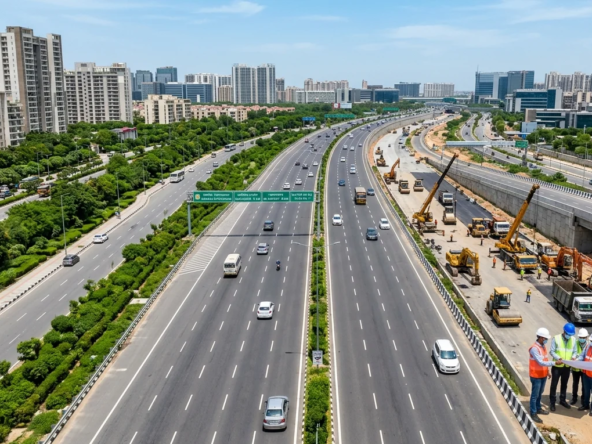
In addition, government initiatives such as smart cities and improved connectivity are creating new opportunities. Cities like Gurgaon are already benefiting from these developments. As infrastructure expands, property values and demand will likely increase further.
Therefore, both developers and investors remain optimistic about the future.
Expert Insight

Sanjeev Singh, MD, SKJ Landbase, shared his perspective on the current trend:
This surge in capital inflows clearly reflects the growing confidence in India’s real estate sector. Investors now recognize real estate as a structured and dependable asset class. Especially in Delhi-NCR, infrastructure growth and urban expansion continue to drive strong demand. Moving forward, we expect both domestic and international investments to accelerate even further.
Conclusion: A Defining Moment for Indian Real Estate
To sum up, the $5.1 billion inflow in Q1 2026 marks a defining moment for the industry. It highlights strong investor confidence, rising institutional participation, and a shift toward organized growth.
Developers continue to lead investments, while REITs strengthen the market structure. At the same time, top cities like Bengaluru, Mumbai, and Delhi-NCR drive the majority of growth.
As the sector evolves, opportunities will expand across residential, commercial, and mixed-use segments. For investors, this phase offers strong potential.
Ultimately, India’s real estate story is no longer just about growth. It is now about stability, structure, and long-term value creation.