India’s Green Energy Mission Is Reshaping Real Estate
India’s renewable energy sector has entered a completely new growth phase. While the country continues focusing on clean and sustainable power, another major transformation has quietly started taking shape alongside it. This time, the spotlight has shifted toward industrial real estate, warehousing, and land acquisition.
According to a recent report by Colliers India, renewable energy companies may lease up to 7 million sq ft of industrial and warehousing space annually by 2030. Simultaneously, solar and wind energy projects could unlock nearly $10–15 billion worth of land acquisition opportunities across India.
As a result, India’s green energy push now looks far bigger than just an environmental mission. In fact, it has started creating one of the largest growth opportunities for the country’s real estate and infrastructure sectors.
Renewable Energy Manufacturing Is Growing at Record Speed
India currently stands among the world’s fastest-growing renewable energy markets. The country’s installed renewable energy capacity touched 251 GW in 2025. More importantly, solar and wind energy contribute almost 75% of the total installed renewable energy mix.
Now, India aims to achieve 500 GW of non-fossil fuel energy capacity by 2030. Therefore, companies involved in solar panels, wind turbines, battery storage systems, semiconductors, and renewable energy equipment have accelerated expansion aggressively.
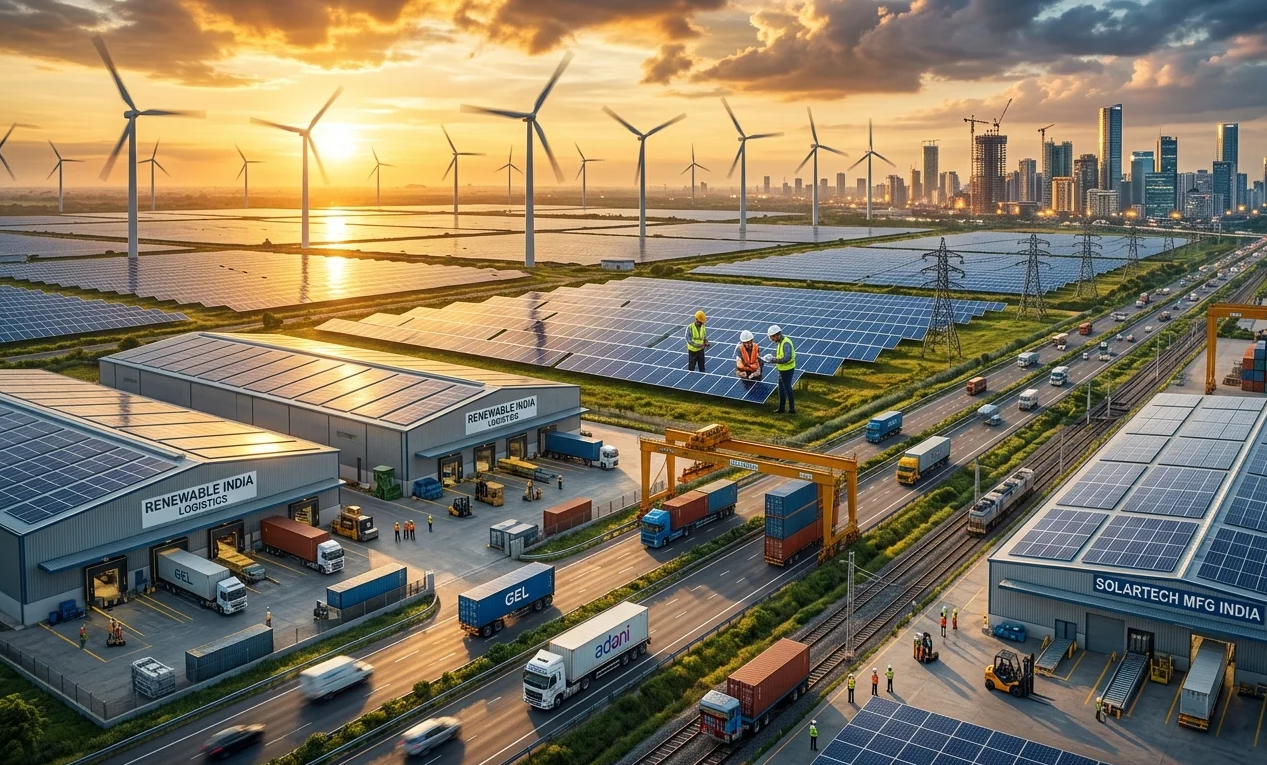
This rapid industrial growth naturally increases the demand for factories, logistics hubs, assembly plants, and storage facilities. Consequently, industrial and warehousing demand from renewable energy manufacturers has risen sharply during the last few years.
The report reveals that renewable energy OEMs leased nearly 6.1 million sq ft of Grade A industrial and warehousing space across India’s top eight cities between 2021 and 2025. Even more significantly, the sector’s share in overall industrial leasing jumped from 3% to 8% during the same period.
That rise clearly highlights how renewable energy has become a serious demand driver for India’s industrial real estate market.
Warehousing Demand Could Reach 7 Million Sq Ft Every Year
The warehousing sector now stands at the center of India’s renewable energy growth story. Manufacturers require massive storage spaces for raw materials, solar modules, batteries, machinery, and finished products. At the same time, logistics operators need efficient supply chains to support project execution across multiple states.
Because of this, annual leasing activity from renewable energy companies has witnessed explosive growth.
Over the last five years alone, annual warehousing demand from renewable energy OEMs increased nearly four times. By 2025, annual leasing reached almost 3 million sq ft.
According to Vimal Nadar, annual Grade A industrial and warehousing demand from renewable energy companies could touch 4–7 million sq ft by 2030. Moreover, the sector may account for nearly 10–15% of India’s total industrial and warehousing demand by the end of the decade.
Naturally, this trend creates huge opportunities for industrial developers, warehouse operators, institutional investors, and logistics companies.
Chennai and Pune Lead the Renewable Energy Race
Among India’s major industrial cities, Chennai and Pune have emerged as the biggest renewable energy warehousing hubs.
Together, both cities accounted for almost two-thirds of the total warehousing space leased by renewable energy firms since 2021. Several important factors continue driving this growth.
First, both cities offer strong manufacturing ecosystems. Second, they provide excellent connectivity through ports, highways, and industrial corridors. Third, companies also benefit from skilled labor availability and supplier networks.
Apart from Chennai and Pune, cities such as Ahmedabad, Bengaluru, Delhi NCR, Hyderabad, Kolkata, and Mumbai also continue witnessing strong industrial demand from renewable energy manufacturers.
Consequently, India’s industrial map continues evolving rapidly around clean energy infrastructure.
Solar and Wind Projects May Unlock $15 Billion Land Deals
One of the biggest impacts of renewable energy expansion may appear in India’s land market. Solar and wind energy projects require enormous land parcels for setup and operations. Therefore, land aggregation has become one of the most important aspects of renewable energy development.
According to the report, India may require nearly 7 lakh acres of land by 2030 for upcoming solar and wind energy projects. Because of this massive requirement, land aggregation and acquisition opportunities may generate investments worth $10–15 billion.
Additionally, land acquisition itself contributes nearly 10–12% of the total renewable energy project cost. Since renewable energy investments may cross $110–120 billion over the coming years, demand for strategically located land parcels will likely rise dramatically.
As a result, several emerging locations across Tier-II and Tier-III cities may witness rapid infrastructure development, economic activity, and investor interest.
Renewable Energy Growth Will Also Boost Housing Demand
The renewable energy boom will not remain limited to warehouses and industrial parks alone. In reality, it could transform entire local economies.
As renewable energy manufacturing hubs expand, workers, engineers, and corporate professionals will require housing, commercial spaces, hotels, retail markets, and social infrastructure nearby.
Consequently, affordable housing projects, rental accommodations, and industrial townships may witness strong growth across emerging renewable energy corridors.
Simultaneously, office demand for training centers, research facilities, and operational headquarters may also increase steadily.
This broader ecosystem development could eventually create long-term sustainable growth across multiple regions in India.
Sanjeev Singh Shares His Perspective on the Green Energy Opportunity

Sanjeev Singh, MD of SKJ Landbase, believes the renewable energy sector will become one of the strongest growth drivers for India’s industrial real estate market during the next decade.
According to him, renewable energy expansion has already started transforming infrastructure development patterns across several emerging locations. He says investors and developers who identify upcoming renewable energy corridors early may benefit from rising land values, growing industrial demand, and long-term commercial growth.
He further adds that warehousing, industrial parks, and strategically located land parcels connected to renewable energy projects could become highly valuable assets in the coming years.
India’s Renewable Energy Sector Is Creating the Next Big Real Estate Wave
India’s renewable energy mission now goes far beyond sustainability. It has started unlocking enormous opportunities across warehousing, industrial real estate, land acquisition, housing, and infrastructure development.
Warehousing demand continues rising rapidly. Industrial cities continue attracting fresh investments. Simultaneously, land markets across emerging regions are witnessing growing interest from developers and investors.
Most importantly, renewable energy growth now combines economic expansion with sustainable development.
As India moves closer toward its ambitious 2030 clean energy targets, the renewable energy sector may emerge as one of the biggest catalysts for the country’s next industrial and real estate boom.