 by SKJ Landbase
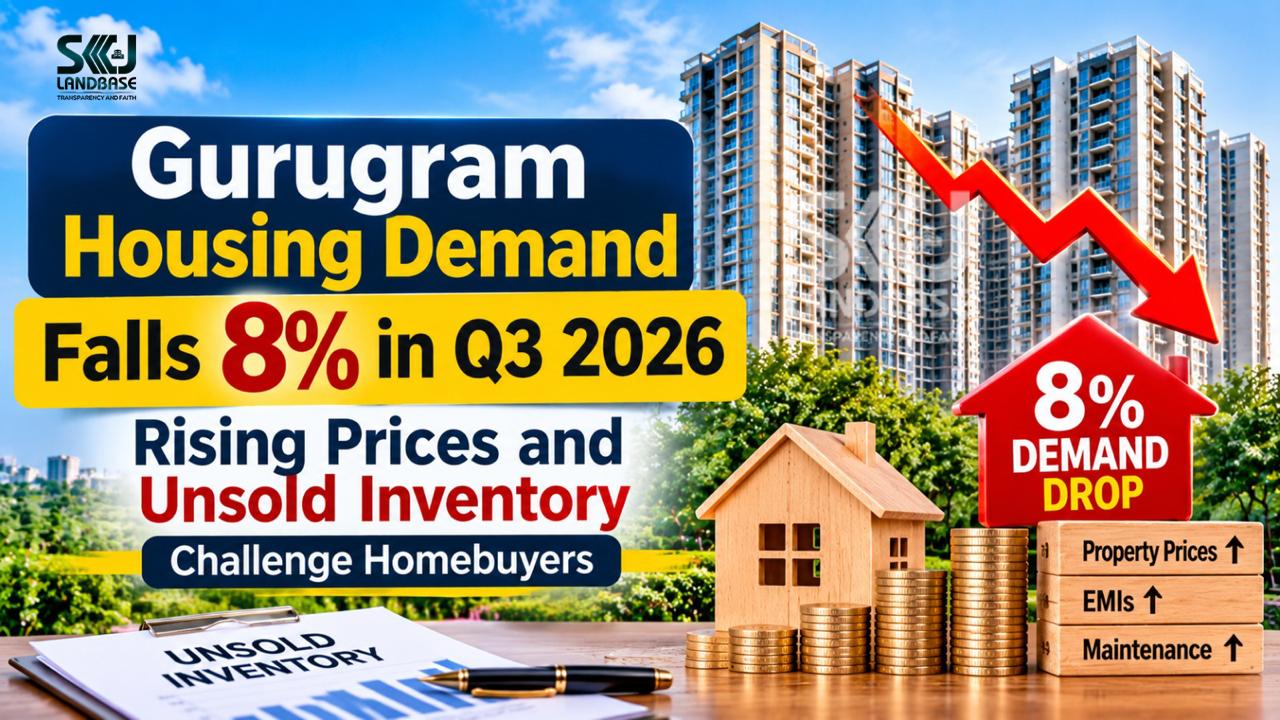
Gurugram Housing Demand witnessed an 8% year-on-year decline in Q3 2026, highlighting growing affordability concerns in the city’s residential real estate market. Rising property prices, higher home loan EMIs and increasing maintenance charges have made buyers more cautious. Meanwhile, developers face growing pressure to manage unsold inventory and adapt to changing homebuyer expectations.
Gurugram’s residential property market continues to attract investors and end-users. However, the latest Q3 2026 data reveals a shift in buyer behavior.
According to NoBroker’s Q3 2026 residential real estate report, housing demand in Gurugram declined 8% year-on-year. During the same period, residential property prices increased 8%.
This gap highlights a growing affordability challenge. Buyers still explore residential properties, but rising prices make them more selective about budgets, locations and apartment configurations.
The market also shows different trends across sales, new launches and available inventory. While some reports record stable or growing sales, others highlight pressure in premium housing segments.
For Gurugram developers, the next phase will require better pricing strategies, suitable housing configurations and a stronger focus on genuine buyer demand.
Gurugram Housing Demand Falls 8% in Q3 2026
NoBroker’s Q3 2026 report recorded an 8% year-on-year decline in housing demand in Gurugram. Noida also recorded a 9% decline during the same quarter.
However, residential prices continued to rise. Gurugram recorded 8% annual price appreciation, while Noida registered an 11% increase.
These figures highlight an important change in the NCR housing market. Property prices continue to rise, but buyer interest does not follow the same pace.
Several factors influence this shift:
- Higher property prices increase the initial purchase budget.
- Home loan installments add pressure to monthly household finances.
- Registration charges, interiors and other expenses increase the overall acquisition cost.
- Maintenance charges add to long-term ownership expenses.
- Premium apartment configurations push total ticket sizes beyond many buyers’ budgets.
Consequently, home-buyers now examine the complete cost of ownership before making a purchase decision.
According to industry experts quoted in Moneycontrol’s November 12 report, buyers in Gurugram and Noida increasingly consider more affordable markets such as Faridabad and ready-to-move resale homes.
This trend highlights the growing importance of affordability in Gurugram’s residential market.
What Do Q3 2026 Sales Figures Reveal About Gurugram?
Although NoBroker recorded an 8% decline in buyer demand, other property consultancies reported different sales trends.
ANAROCK’s Q3 2026 report recorded approximately 13,750 residential sales across NCR. The region registered a marginal 1% annual decline.
Gurugram contributed 45% of NCR’s total residential sales. The city also recorded 15% quarterly growth and 3% annual growth.
Knight Frank presented a more cautious picture. Its Q3 2026 report recorded 10,712 residential sales across NCR, marking a 17% year-on-year decline.
These reports use different datasets and methodologies. NoBroker tracks buyer demand through its property platform, while ANAROCK and Knight Frank track residential transactions through their respective research frameworks.
Therefore, buyers and investors should examine each report independently rather than treat platform demand and actual property sales as identical measurements.
Nevertheless, all three reports highlight an important market development: affordability and price positioning increasingly influence buyer decisions.
Unsold Housing Inventory Raises Concerns for Gurugram Developers
Rising unsold inventory presents another important challenge for the residential real estate market.
According to ANAROCK’s Q3 2026 report, NCR recorded approximately 86,200 available residential units. Gurugram accounted for 46% of this inventory, making it the region’s largest residential inventory market.
Gurugram’s available inventory increased 10% year-on-year, although it declined 3% quarter-on-quarter.
The overall NCR inventory overhang stood at 18 months. This figure indicates the estimated time required to absorb available homes at the prevailing sales pace.
Knight Frank also highlighted inventory pressure in the region. Its Q3 2026 report showed that Gurugram accounted for 57% of NCR’s unsold residential stock.
The consultancy also recorded an eight-quarter inventory absorption period for NCR, compared with 7.3 quarters in Q3 2025.
These findings highlight the importance of inventory management.
Developers must carefully evaluate buyer demand before introducing new residential projects. They should also focus on suitable apartment sizes, competitive pricing and realistic launch strategies.
Why Are High Property Prices Affecting Home-buyer Decisions?
Gurugram has experienced significant residential price appreciation over recent years. Premium developments, infrastructure expansion and growing demand for luxury housing have contributed to the city’s changing property market.
However, rising prices also create affordability challenges for middle-income and first-time home-buyers.
Consider the additional expenses that buyers must evaluate before purchasing a home.
1. Higher Property Prices Increase Entry Costs
An increase in property prices directly affects the buyer’s initial investment.
For example, an 8% annual price increase can significantly change the purchase budget of someone considering a premium apartment.
Buyers must also account for stamp duty, registration, GST where applicable, interiors and other transaction expenses.
2. Home Loan EMIs Influence Purchasing Power
Home loan installments represent a major part of many households’ monthly expenses.
Even when lenders offer competitive interest rates, higher property values can increase the total loan requirement.
Knight Frank notes that cumulative interest-rate easing of 125 basis points already reflects in home loan rates. However, further affordability improvements now depend on household income growth and property price trends.
Therefore, buyers increasingly compare loan eligibility, monthly installments and long-term financial commitments before selecting a property.
3. Maintenance Charges Increase Long-Term Ownership Costs
Luxury residential projects offer extensive amenities, landscaped spaces, clubhouses and advanced security systems.
However, these facilities also involve recurring maintenance expenses.
Buyers now consider monthly maintenance charges alongside EMIs and other household expenses.
As a result, developers must communicate maintenance structures clearly and demonstrate the value that their amenities provide.
4. Premium Apartments Require Larger Budgets
Gurugram’s residential market has increasingly focused on luxury and high-ticket housing.
However, not every buyer can afford large-format apartments or premium residences.
This situation creates opportunities for developers who understand different buyer segments and introduce homes that match their purchasing capacity.
Gurugram’s Luxury Housing Market Faces a Reality Check
Gurugram remains an important destination for luxury housing, but recent market figures highlight a change in buyer behavior.
Knight Frank’s Q3 2026 report identified significant weakness in NCR’s ₹5 crore–₹10 crore residential segment.
Sales in this category declined 63% year-on-year to 925 units during Q3 2026. Meanwhile, unsold inventory in the same price category increased 33%.
Gurugram accounted for a major share of this market correction.
The report also noted that Gurugram’s annual residential price growth slowed to 4%, compared with 32% a year earlier.
These numbers suggest that buyers increasingly question premium property valuations and take more time to evaluate purchase decisions.
However, this does not indicate that Gurugram has lost its position as a major luxury housing destination.
Instead, developers must align premium pricing with genuine demand, product quality, location advantages and delivery confidence.
What Should Real Estate Developers Do to Manage Unsold Inventory?
The changing market requires developers to adopt more disciplined sales and launch strategies.
Here are five important steps that can help developers respond to current market conditions.
1. Introduce Homes Across Different Price Segments
Developers should evaluate demand across affordable, mid-segment, premium and luxury housing categories.
A balanced product mix can help them attract a wider range of home-buyers.
2. Focus on Genuine Buyer Demand
Developers should study actual inquiries, site visits, booking conversions and customer budgets before announcing new launches.
This approach can help them avoid unnecessary inventory accumulation.
3. Offer Transparent Pricing
Home-buyers need clarity about base prices, additional charges, payment plans and maintenance expenses.
Transparent pricing can improve buyer confidence and reduce uncertainty during the purchase process.
4. Strengthen Project Differentiation
Developers should focus on location, connectivity, construction quality, amenities and practical apartment layouts.
A clear value proposition can help projects compete in a market where buyers increasingly compare multiple options.
5. Prioritize Delivery Confidence
Home-buyers increasingly evaluate project timelines, developer credibility and construction progress.
Therefore, developers must maintain clear communication and demonstrate their ability to meet project commitments.
What Does the Q3 2026 Housing Market Mean for Gurugram Home-buyers?
The latest market data presents both opportunities and challenges for property buyers.
The slowdown in buyer interest can encourage more careful negotiations and stronger property comparisons.
However, buyers should not assume that every developer will reduce prices or offer substantial discounts.
Gurugram continues to attract residential demand through its corporate ecosystem, employment opportunities and expanding infrastructure network.
Buyers should focus on five important considerations:
- Compare property prices across neighboring sectors.
- Evaluate the developer’s delivery record and financial credibility.
- Calculate the complete purchase cost, including registration and interiors.
- Examine monthly maintenance charges and recurring expenses.
- Check project approvals, RERA registration and payment schedules.
Additionally, buyers should compare ready-to-move properties with under-construction developments before making a final decision.
A well-researched purchase can help homeowners balance location advantages, affordability and long-term value.
Expert Perspective: Sanjeev Singh, Managing Director of SKJ Landbase
Sanjeev Singh, believes that Gurugram’s residential market has entered a more selective phase.

He says:
“Today’s home-buyers evaluate much more than location and amenities. They carefully examine the total purchase cost, monthly EMIs, maintenance expenses and the developer’s track record.
Gurugram continues to offer excellent residential opportunities. However, developers must understand changing buyer expectations and introduce projects that deliver genuine value.
I believe the market now needs a stronger balance between premium development and affordability. Buyers want quality homes, excellent connectivity and modern amenities, but they also expect transparent pricing and long-term value.
At SKJ Landbase, we encourage buyers to compare projects carefully, understand their financial commitments and evaluate the developer before making an investment decision.
The future of Gurugram real estate will depend not only on new launches but also on how effectively developers respond to genuine home-buyer demand.”
Conclusion: Gurugram Real Estate Enters a More Selective Housing Market
Gurugram’s Q3 2026 residential market data highlights an important shift in buyer behavior.
NoBroker recorded an 8% annual decline in buyer demand, while ANAROCK reported 3% annual growth in actual residential sales. Meanwhile, Knight Frank highlighted a sharp slowdown in NCR sales and growing pressure in premium housing inventory.
Together, these findings show that Gurugram’s housing market does not face a uniform demand slowdown. Instead, different price segments and buyer categories now experience different market conditions.
High property prices, home loan commitments and recurring maintenance expenses make buyers more selective.
Developers must respond with realistic pricing, suitable housing configurations and stronger inventory management.
For home-buyers, this phase offers an opportunity to research projects carefully and make informed financial decisions.
At SKJ Landbase, we believe the best property investment begins with the right location, the right developer and a clear understanding of long-term value.