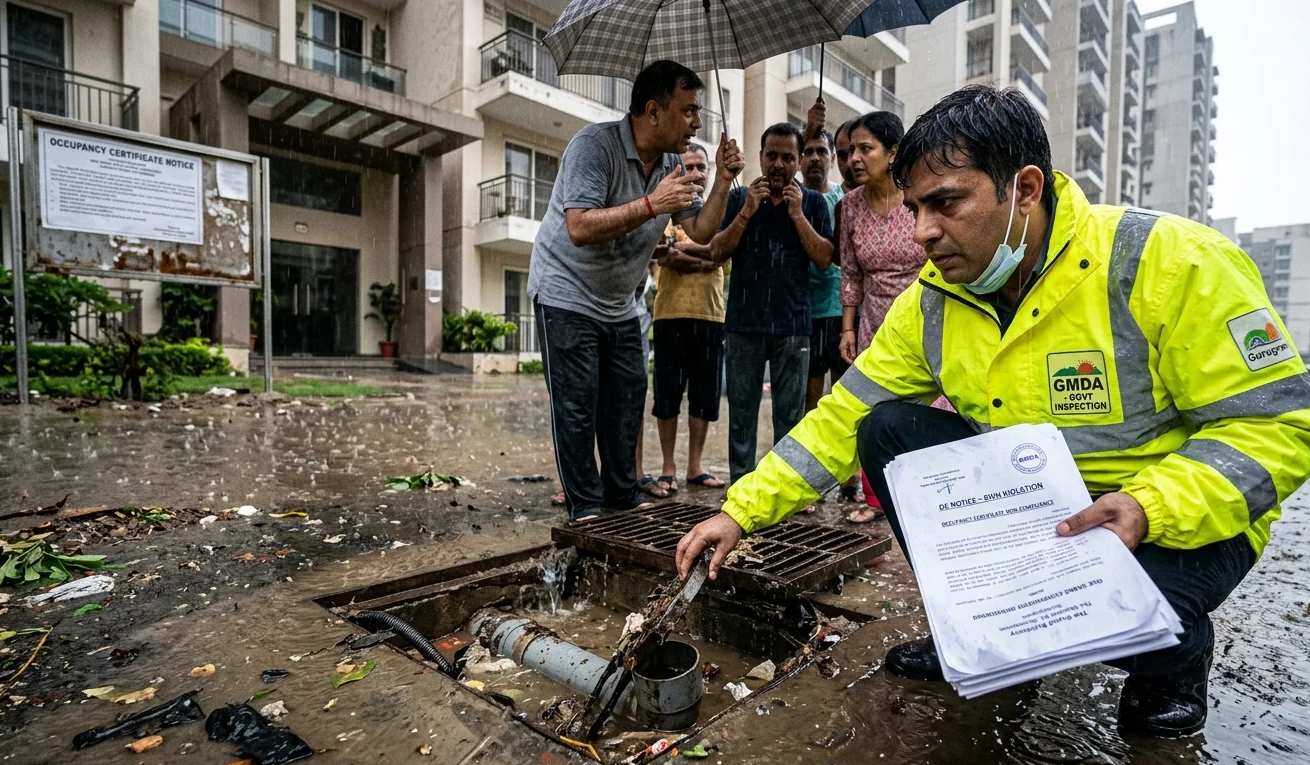
Haryana Introduces Strict Action on Rainwater Harvesting Systems
The Haryana government has introduced a major reform that could significantly impact homeowners, residential societies, and developers across the state. Under the amended Haryana Building Code 2017, authorities can now recommend cancellation of Occupancy Certificates (OCs) for properties where rainwater harvesting (RWH) systems remain non-functional.
This decision comes as Haryana continues to struggle with groundwater depletion, urban flooding, and waterlogging issues, especially in rapidly developing cities like Gurugram. Although rainwater harvesting systems already existed as a mandatory requirement in many projects, several societies and individual property owners reportedly failed to maintain them after obtaining approvals.
Therefore, the government has decided to tighten enforcement and ensure that these systems work properly throughout the life of the property.
The amendment has already become a major talking point in the real estate sector because it directly connects environmental compliance with occupancy rights.
What the New Haryana Amendment Says
The Department of Town and Country Planning (DTCP) issued the amendment through an official notice dated May 12. According to the revised rule, property owners must now submit an online self-certification confirming that their rainwater harvesting systems function properly.
At the same time, the government has empowered authorities to conduct periodic inspections of properties where RWH systems were installed as a condition for obtaining occupancy certificates.
The inspections will cover:
- Individual residential houses
- Plotted colonies
- Group housing societies
- Condominiums
- Commercial properties
If inspectors identify deficiencies or neglected systems, property owners will receive notices directing them to fix the problems within four weeks.
However, the consequences become serious if owners ignore the notice.
Authorities may begin penal action after the initial deadline. Moreover, continued non-compliance for eight weeks from the first notice may lead to revocation of the occupancy certificate.
This amendment finally gives authorities stronger legal backing to act against faulty or inactive rainwater harvesting systems.
Why Rainwater Harvesting Has Become So Important
Rainwater harvesting now plays a crucial role in urban infrastructure and environmental sustainability. These systems help recharge groundwater, reduce pressure on municipal water supplies, and minimize flooding during heavy rainfall.
Unfortunately, many projects installed rainwater harvesting structures only to complete formal approval requirements. Later, maintenance often stopped completely.
As a result, recharge pits became clogged, pipelines stopped functioning, and water storage systems turned ineffective.
This negligence has contributed to worsening urban drainage problems across Haryana’s growing cities.
According to a drainage report submitted by a GMDA consultant in July 2025:
- Nearly 50% of residential societies had non-functional RWH systems
- Around 85% of houses faced similar problems
- Several recharge wells and pits required immediate restoration and cleaning
These alarming findings pushed the government to take stronger regulatory action.
Without proper rainwater harvesting, cities continue to experience severe waterlogging during monsoon seasons while groundwater levels keep falling every year.
Authorities to Begin Large-Scale Inspections
Officials have confirmed that inspections will begin soon after strengthening legal provisions through the amendment.
Authorities from Gurugram Metropolitan Development Authority (GMDA) already conducted inspections in several condominiums. During these checks, officials discovered multiple non-functional systems that required urgent restoration.
Housing societies received instructions to repair and reactivate their rainwater harvesting infrastructure immediately.
RS Bhath, District Town Planner (Enforcement), GMDA, described the amendment as an important step toward environmental accountability.
According to him, authorities previously lacked sufficient legal powers to take strict action against neglected systems. Now, inspection teams can officially monitor, report, and recommend action under the revised framework.
Consequently, property owners and RWAs can no longer ignore regular maintenance responsibilities.
Big Impact on Homeowners and Housing Societies
The new regulation creates direct responsibility for homeowners, RWAs, and developers.
Now, property owners must ensure that:
- Recharge pits remain functional
- Pipelines stay unclogged
- Desilting chambers remain clean
- Water storage structures work efficiently
- Rainwater flows correctly into recharge zones
Housing societies may also need regular maintenance contracts and periodic technical inspections to avoid penalties.
Furthermore, buyers may begin checking the condition of rainwater harvesting systems before purchasing homes. Consequently, properly maintained infrastructure could positively influence property value and buyer confidence.
Developers will also face greater scrutiny during project completion and handover stages.
The amendment clearly signals that environmental compliance can no longer remain limited to paperwork.
Haryana Pushes Sustainable Urban Development
Haryana’s latest move reflects a larger push toward sustainable urban planning and water conservation.
Rapid urbanization across NCR regions has increased concrete construction dramatically. Because of this, natural groundwater recharge has reduced significantly over the years.
At the same time, climate change and irregular rainfall patterns have intensified flooding and drainage challenges.
Therefore, functional rainwater harvesting systems have become essential for future-ready cities.
Experts believe stricter enforcement can improve groundwater levels, reduce urban flooding, and strengthen water management infrastructure across Haryana.
Additionally, properly maintained systems can reduce dependence on external water supply sources and improve long-term sustainability.
Expert Opinion by Sanjeev Singh, MD, SKJ Landbase

Sanjeev Singh, Managing Director of SKJ Landbase, believes the amendment will bring greater accountability within the real estate sector.
He says, “Rainwater harvesting should never remain a symbolic requirement completed only during project approvals. Functional systems are extremely important for groundwater recharge and urban flood prevention. Haryana’s decision will encourage developers, societies, and homeowners to maintain sustainability standards more responsibly.”
He also stated that environmentally conscious infrastructure now plays a major role in modern homebuyer preferences.
Final Thoughts
Haryana’s decision to strengthen rainwater harvesting enforcement marks a major shift in urban governance and environmental regulation.
The government now wants actual functionality instead of temporary compliance.
Although the amendment may create additional responsibilities for homeowners and societies, it can deliver long-term benefits for water conservation, groundwater recharge, and flood management.
As inspections begin soon, property owners should immediately inspect and maintain their rainwater harvesting systems.
Because under Haryana’s new rules, neglecting maintenance could eventually put occupancy certificates at serious risk.