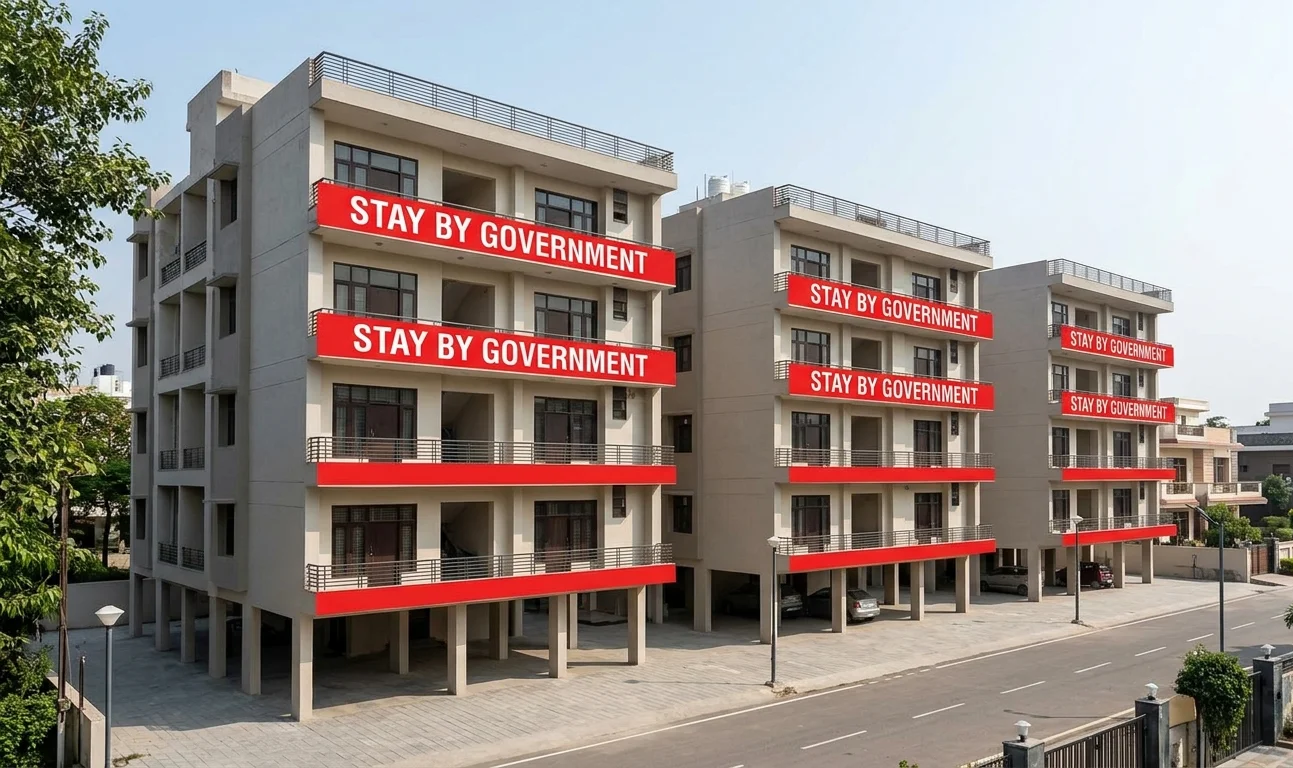
What Triggered the Sudden Halt?
Haryana’s real estate landscape has witnessed a major shift. The state government has put all approvals for the Stilt+4 floors policy on hold. This decision came immediately after an interim order from the Punjab and Haryana High Court on April 2, 2026.
Soon after, the Department of Town and Country Planning issued strict instructions. It directed authorities like Haryana Shehri Vikas Pradhikaran and Haryana State Industrial and Infrastructure Development Corporation Limited to stop granting any approvals related to Stilt+4 constructions.
As a result, developers, builders, and property owners now face a sudden pause in planning and execution.
The Core Reason Behind the Court’s Decision
Now, let’s break down the reason behind this strong intervention.
The matter came up in the case Sunil Singh vs State of Haryana. During the hearing, the High Court raised serious concerns about the lack of infrastructure readiness, especially in rapidly growing cities like Gurugram.
The court clearly stated that increasing floor density without upgrading infrastructure could create long-term chaos. In fact, the judges emphasized that urban planning must go hand in hand with infrastructure expansion.
Therefore, they decided to stay the policy until the government provides a clear roadmap.
Infrastructure Issues Can No Longer Be Ignored
Interestingly, infrastructure became the central issue in this case.
The High Court highlighted several ongoing problems:
- Sewage systems already operate beyond capacity
- Drainage networks fail during heavy rainfall
- Traffic congestion continues to worsen
- Flooding remains common in low-lying areas
Moreover, ground inspections revealed that internal roads in many residential sectors have effectively narrowed. Encroachments, illegal parking, and rising population density have made movement difficult.
Consequently, emergency services also face delays in such areas. This raises serious safety concerns.
Expert Committee Warnings Were Overlooked
What makes this situation more critical is the fact that warnings already existed.
An expert committee led by P Raghavendra Rao had earlier recommended a mandatory infrastructure capacity audit before implementing the Stilt+4 policy.
However, authorities did not fully act on these recommendations.
As a result, the High Court took note of this gap. It stressed that policies affecting urban density must rely on data-driven planning, not assumptions.
The ₹689 Crore Question
Another major concern revolves around funds.
The government had collected around ₹689.80 crore under purchasable development rights. This amount was transferred to HSVP in September 2024.
However, authorities have not yet provided a clear update on how this money has been used.
This raises important questions:
- Has the infrastructure improved after this funding?
- If yes, why do issues still persist?
- If not, what caused the delay?
Because of this lack of transparency, the court has demanded accountability.
Immediate Impact on Developers
Undoubtedly, this decision has created uncertainty in the real estate market.
Developers who planned projects under the Stilt+4 model must now pause approvals. In many cases, construction timelines may shift. Some projects might even require redesigning.
Additionally, smaller builders who depended heavily on this policy could face financial pressure.
However, at the same time, this pause encourages developers to rethink long-term sustainability.
What Should Homebuyers Expect?
For homebuyers, the situation presents both challenges and opportunities.
On the one hand, delays in approvals may affect possession timelines. Buyers waiting for under-construction floors might need to stay patient.
On the other hand, this move protects buyers from future infrastructure failures.
Better planning will ensure:
- Improved road connectivity
- Efficient drainage systems
- Reduced congestion
- Higher quality of living
Therefore, while the halt feels inconvenient now, it strengthens the foundation for future growth.
Gurugram Remains in Sharp Focus
The spotlight clearly falls on Gurugram.
Over the years, the city has expanded rapidly. However, infrastructure development has struggled to keep pace.
Daily traffic jams, frequent waterlogging, and sewer issues highlight the imbalance.
Because of this, the High Court has emphasized a simple yet powerful principle – growth must remain sustainable.
Industry Insight by Sanjeev Singh

Sanjeev Singh, MD of SKJ Landbase, shared a practical perspective on the situation:
This move may slow down the market temporarily. However, it creates a necessary checkpoint. Infrastructure must lead development, not follow it. In the long run, this approach will increase buyer confidence and improve project quality.
His statement reflects the industry’s growing focus on long-term value rather than short-term gains.
What Lies Ahead?
Looking forward, the next steps depend on the Punjab and Haryana High Court.
Authorities must now:
- Submit detailed infrastructure audit reports
- Clarify fund utilization
- Present a structured development plan
Only after reviewing these aspects will the court decide whether to lift or modify the policy.
Final Thoughts
To sum it up, Haryana’s decision marks a crucial moment in urban planning.
The halt on the Stilt+4 policy highlights a key lesson – real estate growth cannot ignore infrastructure limits. Although developers and buyers may face short-term disruptions, the long-term benefits remain significant. Better infrastructure, improved livability, and sustainable growth will ultimately define the future of cities like Gurugram.
And that is exactly the direction modern urban India needs.