Namo Bharat RRTS Set to Transform Gurugram–Faridabad–Noida Connectivity: NCRTC Finalises ₹15,000 Cr DPR
The National Capital Region moves into a faster future as NCRTC finalises the ₹15,000 crore Detailed Project Report for the upcoming Namo Bharat RRTS corridor linking Gurugram, Faridabad and Noida. This ambitious 61-km line reshapes mobility across the most dynamic parts of the NCR. And now, with the DPR ready, the project moves closer to groundbreaking.
Work begins in December 2026, and NCRTC targets a 4.5-year completion window. The corridor connects major economic hubs, dense residential belts and upcoming growth pockets, so its impact spreads far beyond high-speed travel. It injects efficiency, reduces road pressure and builds confidence in India’s new-age mobility systems.
A Well-Planned 61 km Route Connecting Key NCR Nodes
The alignment starts from IFFCO Chowk in Gurugram a major interchange already identified as the starting point of the Delhi–Bawal Namo Bharat corridor. This creates a connected ecosystem instead of isolated links. From here, the route moves toward Millennium City Centre, an important commercial zone, and reaches Brigadier Osman Chowk, which anchors large business and residential districts.
As the route turns eastward, the train glides through Gwal Pahari and follows the Faridabad–Gurugram Road (MDR-137). This alignment reduces land conflict and connects two major cities without cutting through saturated road networks. It then touches Hanuman Mandir/Badkhal Enclave, a key node that bridges local population clusters.
The corridor continues along Shaheed Bhagat Singh Marg, enters Bata Chowk, and then heads toward the BPTP Bridge. From there, it moves through Amolik Chowk, reaches Amrita Hospital, and jumps onto the FNG Expressway a stretch planned to handle massive future traffic flow.
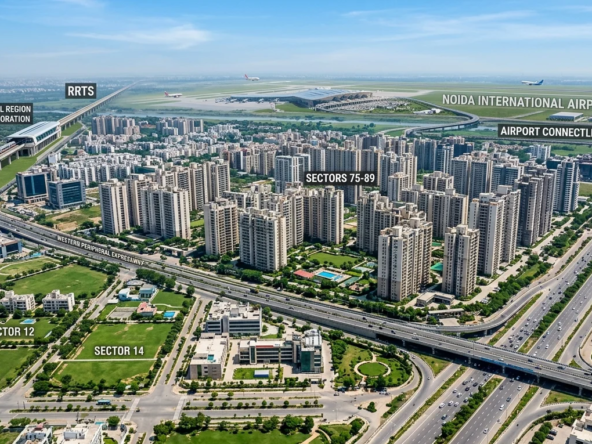
The train then enters Noida at Sector 168 and travels further east, finally terminating at Surajpur Junction in Greater Noida. Surajpur also becomes the interchange that links Ghaziabad with the upcoming Noida International Airport (Jewar), which adds enormous value for long-distance travellers.
This corridor brings six stations two each in Gurugram and Faridabad, and one each in Noida and Greater Noida.
Modern, High-Capacity Trains That Redefine Speed and Comfort
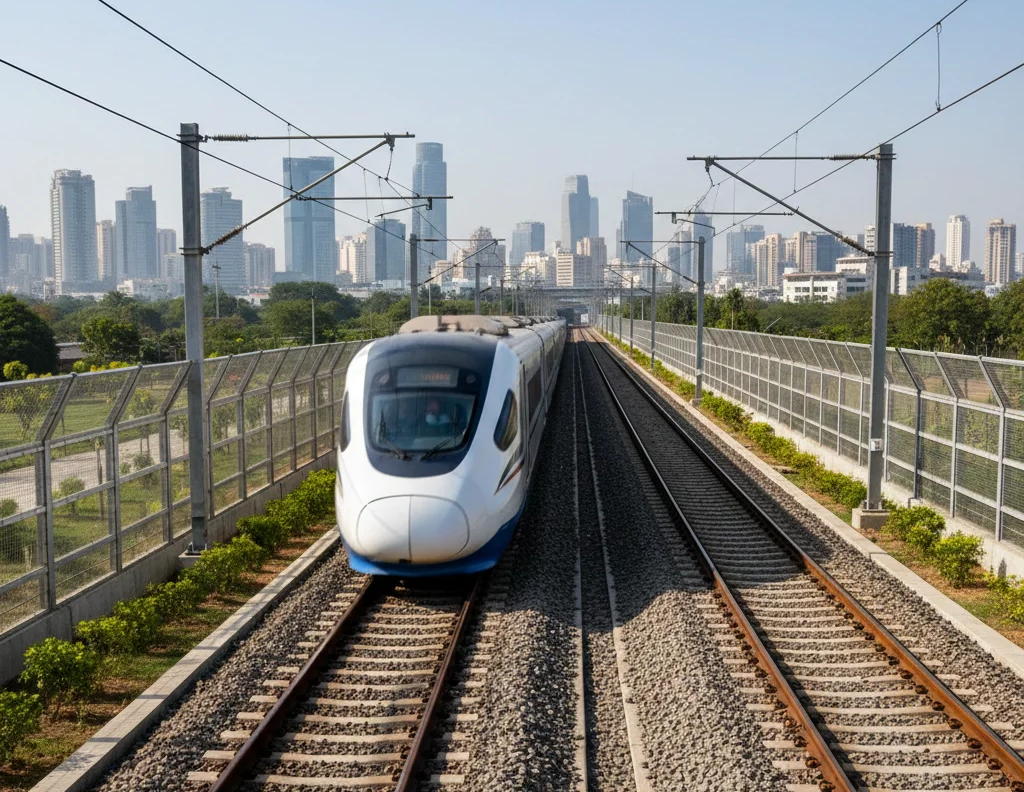
The project starts with 10 six-coach Namo Bharat trains. Each train carries 1,928 people, including 408 comfortable seats. These trains run with smooth acceleration, silent braking and advanced safety systems. The capacity planning looks ahead to long-term demand, not just present needs.
Ridership forecasts show rapid growth. By 2031, the corridor expects 3.84 lakh daily passengers. This number jumps to 8.53 lakh by 2054, which proves the NCR’s shift toward high-speed mass mobility. People want faster travel, and they want reliability. This corridor gives both.
The DPR identifies the need for 75 hectares of land. NCRTC prepared acquisition numbers early so project timelines remain stable.
A Corridor That Reduces Congestion and Improves NCR’s Mobility Health
The NCR struggles with road congestion every day. Office commuters lose hours in traffic. Logistics slow down. Fuel consumption increases. And pollution rises. This corridor brings a direct and immediate solution.
People get a faster alternative to cars, bikes, cabs and buses. Travel time between Gurugram, Faridabad and Noida drops sharply. And because stations sit near major job centres, thousands of office-goers shift to rapid rail. The shift reduces road load and cleans the air around busy corridors.
This new line also ties into the Centre’s other major priorities the Delhi–Bawal and Delhi–Karnal Namo Bharat routes. Together, these high-speed corridors reshape NCR’s mobility grid over the next decade.
A Clear Push From the Centre Toward Faster Urban Mobility
Union Minister for Housing and Urban Affairs Manohar Lal Khattar reinforced the Centre’s commitment to new-age mass transit. He highlighted the importance of fast connections between Delhi, Gurugram, Faridabad and Noida. He also emphasized the upcoming Gurugram–Dwarka metro link, which adds another strong layer of connectivity.
His message signals a big shift. India wants mobility reforms that reduce pressure on roads, improve air quality and enable faster economic growth. This RRTS aligns perfectly with that vision.
Expert Insight: Sanjeev Singh, MD, SKJ Landbase

Sanjeev Singh explains the impact of this corridor from a real estate and infrastructure perspective. He says:
“The Namo Bharat corridor between Gurugram, Faridabad and Noida will change everything for daily commuters. People finally get a fast, predictable and world-class transit option. And as transit improves, real estate values around stations grow faster. Infrastructure drives confidence, and this project adds exactly that confidence to the NCR.”
His view reflects the reality on the ground. Homebuyers increasingly prefer well-connected neighbourhoods, and investors look for markets linked to upcoming infrastructure. This RRTS unlocks both sides.
A Larger Vision for a Cleaner, Smarter and More Connected NCR
The Gurugram–Faridabad–Noida RRTS stands as more than just a transport project. It represents NCR’s shift toward cleaner mobility, faster travel and better urban planning also lifts the region’s economic momentum. It reduces daily stress for lakhs of commuters. And it supports the future airport ecosystem at Jewar.
As construction begins in 2026, the NCR enters a critical phase of infrastructure transformation. The corridor boosts accessibility, shapes real estate growth patterns and upgrades the region’s competitiveness.
The NCR grows rapidly when mobility grows first. This corridor brings exactly that push strong, decisive and future-ready.