India’s Real Estate Future: Housing Prices to Rise 5–10% Annually, Sales to Double by 2047
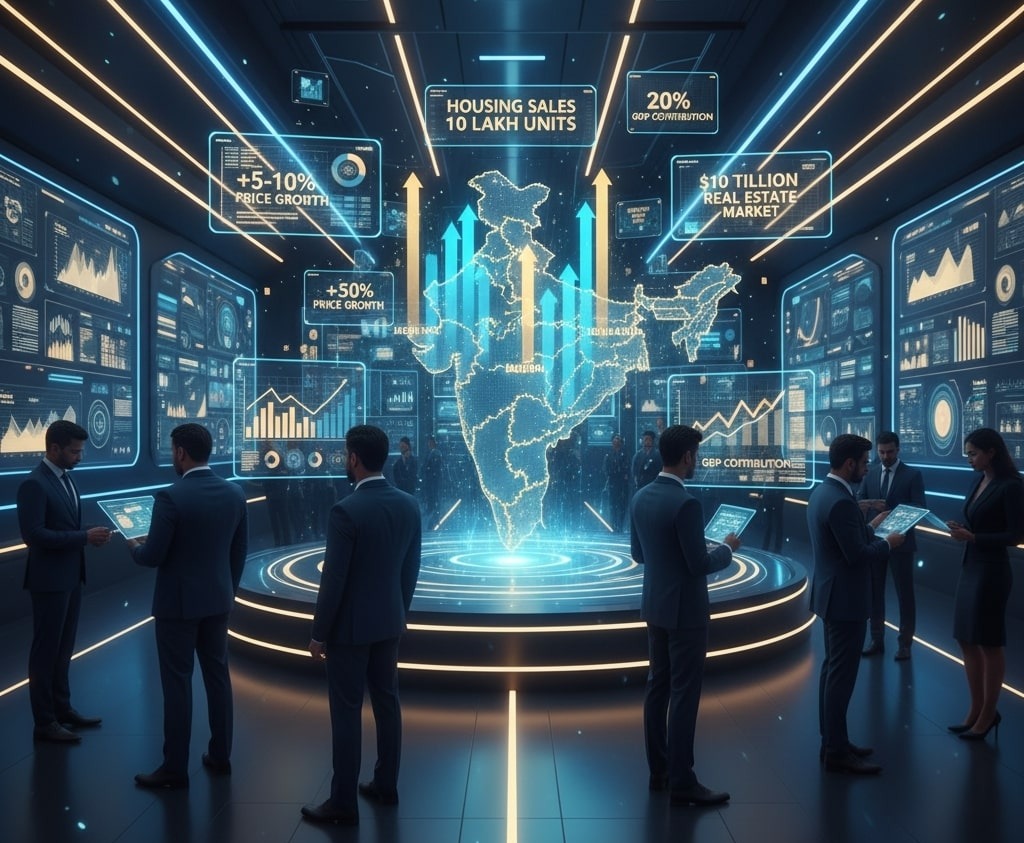
India’s real estate market is gearing up for a historic transformation. According to a new report by CII and Colliers India, housing prices are likely to rise by 5–10% every year, while sales could double to 10 lakh units by 2047.
This growth is not a coincidence it’s the result of rising household incomes, rapid urbanization, better infrastructure, and supportive government policies. In simple words, the next two decades may redefine how Indians live, invest, and dream.
Rising Incomes and a Young Population Drive Demand
The report, titled “Real Estate @2047: Building India’s Future Growth Corridors,” highlights one clear truth India’s people are getting younger, wealthier, and more ambitious.
As incomes rise and jobs become more stable, families are finally ready to make one of their biggest life decisions buying a home. Moreover, India’s median age is expected to stay between 30 and 40 years, which is exactly when people reach their highest earning potential.
This means that first-time homebuyers will continue to dominate demand for years to come. As a result, developers are already focusing on modern, smart, and affordable homes that appeal to young families looking for security and comfort.
In addition, better access to credit and increasing financial awareness are encouraging more middle-income buyers to step into the real estate market.
Affordable and Premium Segments Growing Together
Interestingly, the housing boom is not limited to one segment. On one hand, the government’s PMAY (Pradhan Mantri Awas Yojana) and RERA reforms are pushing affordable housing into the mainstream. On the other hand, there’s a sharp rise in demand for luxury and premium homes.
Buyers are no longer just purchasing four walls they are investing in lifestyle, design, and wellness. Furthermore, India’s growing population of High-Net-Worth Individuals (HNIs) and ultra-HNIs are looking for villas, independent floors, and plotted developments that offer exclusivity and long-term appreciation.
Consequently, this dual demand affordable yet aspirational is making the real estate ecosystem far more balanced and dynamic than before.
Tier II and III Cities: The Next Growth Frontiers
While metros like Delhi NCR, Mumbai, and Bengaluru remain the top choices, Tier II and III cities are emerging as the next big real estate frontiers.
Thanks to new expressways, metro expansions, airports, and industrial corridors, cities like Jaipur, Lucknow, Coimbatore, Surat, and Indore are witnessing unprecedented growth.
Moreover, spiritual and heritage cities such as Varanasi, Haridwar, and Ujjain are turning into modern housing hubs. People now prefer peaceful, well-connected towns that provide better air quality, modern infrastructure, and strong returns on investment.
In addition to this, zoning reforms and TDR (Transferable Development Rights) policies are opening up opportunities for redevelopment projects in saturated markets like Mumbai and Delhi NCR.
Therefore, the next wave of real estate growth may not come from traditional metros it will rise from India’s smaller, faster-growing cities.
Infrastructure and Policy: The Real Game Changers
Infrastructure development has become the heartbeat of India’s housing revolution. Every new expressway, metro line, and industrial park adds more value to surrounding land and property.
Government initiatives such as PMAY, RERA, and the SWAMIH Fund have also made buying a home much safer and more transparent. Consequently, both developers and homebuyers are showing renewed confidence in the system.
“India’s infrastructure expansion is reshaping the real estate landscape, unlocking new growth corridors and transforming Tier II and III cities. Expressways and industrial corridors are changing land use patterns, boosting urban development, and creating commercially viable hotspots,” said Harleen Kaur, Deputy Secretary, Ministry of Road Transport and Highways.
Additionally, the synergy between infrastructure and real estate is expected to transform how Indian cities grow. Roads, airports, and digital connectivity are not just improving convenience they’re creating entirely new economic corridors.
From $0.3 Trillion to $10 Trillion: India’s Real Estate Revolution
The numbers speak volumes. The CII–Colliers report predicts that India’s real estate sector, currently valued at $0.3 trillion, could grow to a massive $5–10 trillion market by 2047.
That’s nearly a 20-fold increase, which could make real estate contribute 14–20% of India’s GDP by then.
Moreover, this expansion perfectly aligns with the vision of Viksit Bharat under the Amrit Kaal roadmap, where housing will act as a cornerstone of national progress.
As India urbanizes rapidly, the number of cities with populations exceeding one million could reach nearly 100 by 2047. With each growing city, the demand for housing, infrastructure, and jobs will create a self-reinforcing cycle of development.
Commercial and Emerging Segments Gain Momentum
While residential projects remain the heart of the industry, commercial and industrial real estate are now picking up speed.
Thanks to digital transformation, the Make-in-India push, and a shift toward decentralized workspaces, new business hubs are emerging across the country.
At the same time, data centers, shared offices, co-living spaces, and green industrial parks are becoming attractive investment categories. These modern assets cater to changing lifestyles and work patterns, especially among young professionals.
“In addition to strong demand in traditional sectors, we foresee massive growth in alternative assets like data centers and shared living spaces,” said Badal Yagnik, CEO & MD of Colliers India.
Expert Insight: Sanjeev Singh, MD, SKJ Landbase

Adding his perspective, Sanjeev Singh, Managing Director of SKJ Landbase, said:
“India’s housing market is standing on the edge of historic transformation. With strong fundamentals, growing aspirations, and policy stability, the next 20 years will redefine how Indians live and invest. Gurgaon and the NCR region, in particular, are becoming magnets for premium residential and plotted developments, supported by excellent connectivity and new-age infrastructure.”
He further emphasized that innovation, sustainability, and customer trust will guide the next phase of growth. Developers who can balance affordability with lifestyle value will lead the market.
As a result, Gurgaon, Dwarka Expressway, and Golf Course Extension Road are fast becoming India’s premium growth corridors offering a perfect mix of livability and long-term capital appreciation.
The Road Ahead: Building Urban India 2047
By 2047, India’s urban landscape will look dramatically different. The multiplier effect of income growth, infrastructure investment, and digital transformation will shape every part of the country.
Furthermore, sustainability and technology will be at the center of this change. Cities will become smarter, greener, and more people-friendly.
Developers are already focusing on energy-efficient designs, smart home automation, and green certifications, making India’s new housing stock future-ready.
At the same time, government support for affordable housing and urban redevelopment will ensure that progress remains inclusive and accessible to all.
Final Thoughts
India’s real estate story is no longer just about property it’s about progress. With housing prices expected to grow 5–10% every year, and sales likely to double by 2047, the journey ahead looks both exciting and rewarding.
For investors, this is the time to think long-term. For developers, it’s the moment to innovate and build sustainably. And for families, it’s an era of opportunity where every home represents stability, success, and hope.
The dream of “Housing for All” is taking shape faster than ever. One city, one project, and one home at a time India’s future is truly being built brick by brick.