 by SKJ Landbase
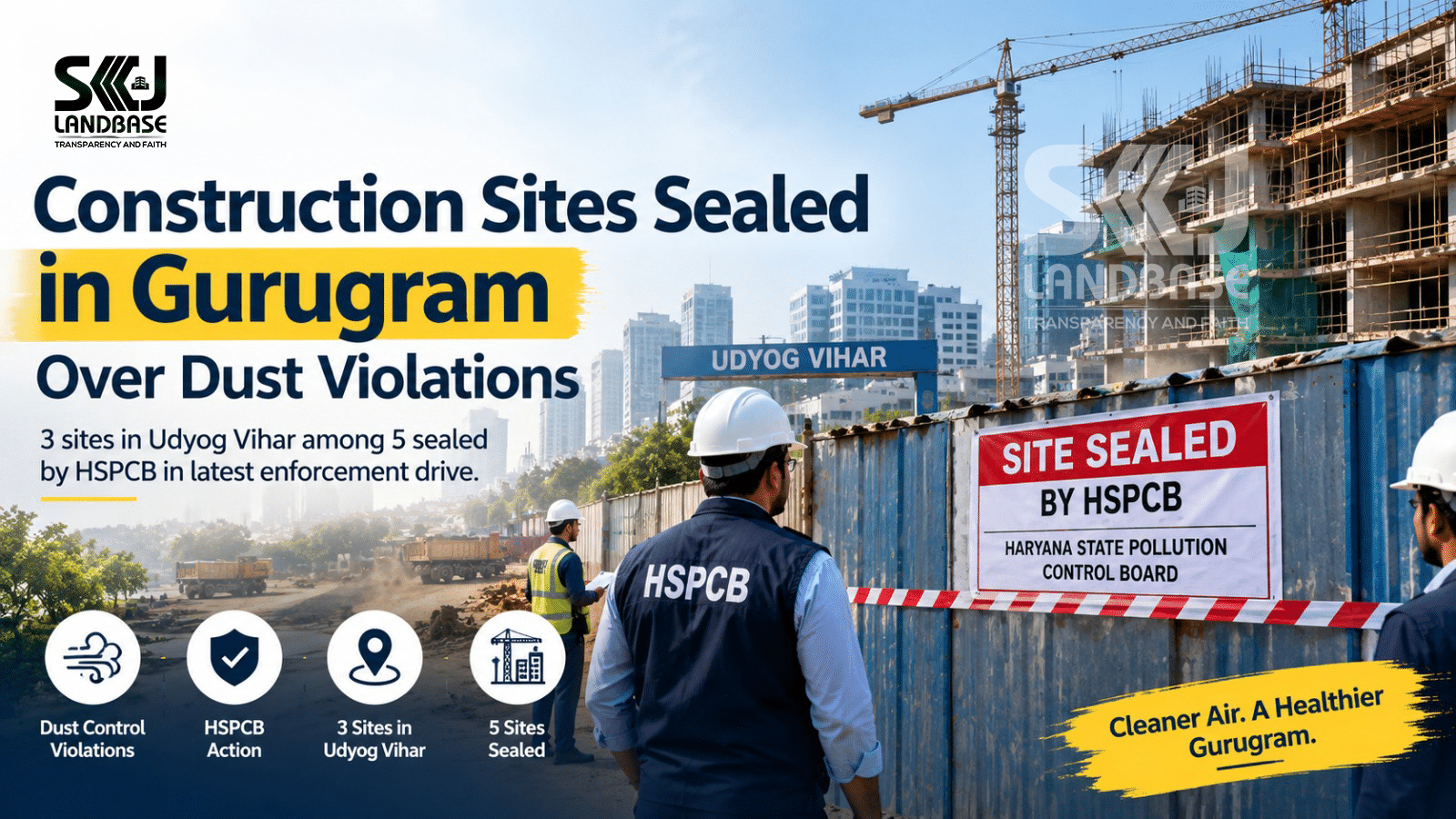
Gurugram’s fight against air pollution has taken a stricter turn. The Haryana State Pollution Control Board (HSPCB) has sealed five construction sites across the city, including three in Udyog Vihar, after officials found violations of mandatory dust-control regulations.
The latest enforcement action sends a strong message to real estate developers, construction companies and infrastructure contractors: Gurugram’s rapid development cannot come at the cost of public health and environmental safety.
As air pollution continues to challenge Delhi-NCR, authorities have intensified inspections and tightened compliance requirements for construction and demolition (CUD) sites. Developers must now pay closer attention to dust-management practices, online monitoring systems and environmental regulations.
The action also highlights an important shift in Gurugram’s real estate sector, where environmental responsibility and construction compliance increasingly matter alongside project quality, location and connectivity.
HSPCB Seals 5 Construction Sites in Gurugram: What Happened?
The Haryana State Pollution Control Board conducted an enforcement drive through its Gurugram North regional office and sealed five construction sites after officials identified violations of dust-control regulations.
Three of these sites operate in Udyog Vihar, while the remaining two fall in other parts of Gurugram.
During inspections, officials found that the sites had failed to follow directions from the Commission for Air Quality Management (CAQM) and meet mandatory requirements on HSPCB’s dust-monitoring portal.
The officials inspected equipment and compliance arrangements at the premises before taking action. They also placed notices at the respective site gates to enforce the sealing orders.
HSPCB has made its position clear: construction sites must follow prescribed pollution-control measures, and officials will continue inspections across Gurugram to identify further violations.
This enforcement drive reflects the authorities’ growing focus on controlling dust emissions from construction activities, which contribute to particulate pollution across the National Capital Region.
Why Did HSPCB Seal These Construction Sites?
Construction activities generate significant amounts of dust through excavation, demolition, material handling, transportation and other on-site operations.
When developers fail to implement proper dust-control measures, these activities release particulate matter into the surrounding environment and worsen air quality.
HSPCB cited violations of CAQM directions and non-compliance with the state dust portal’s requirements as the reasons for sealing the five sites.
The authorities expect developers to implement effective dust-mitigation practices and maintain the required monitoring systems throughout construction.
Some of the important measures include:
- Dust barriers and green screens: Developers must control the movement of dust beyond construction boundaries.
- Regular water sprinkling: Construction teams must suppress airborne dust through appropriate water-sprinkling arrangements.
- Material covering: Developers must cover construction materials and debris to prevent dust from spreading.
- Air-quality monitoring: Eligible construction projects must install the prescribed PM2.5 and PM10 monitoring sensors.
- Digital monitoring: Developers must register eligible projects on the HSPCB dust portal and maintain functional monitoring systems.
These measures help authorities monitor construction activities and identify sites that fail to follow environmental guidelines.
CAQM Makes Dust Monitoring Mandatory for Large Construction Projects
The Commission for Air Quality Management has introduced strict monitoring requirements for construction and demolition projects across Delhi-NCR.
Under its directions, projects with a plot area of 500 square meters or more must register on the respective state pollution-control board’s dust-mitigation portal.
Developers must also install the following monitoring equipment:
1. Geo-Fenced PTZ Cameras
Construction sites must install pan-tilt-zoom (PTZ) cameras with geo-fencing capabilities. These cameras allow authorities to monitor construction activities remotely and verify compliance with dust-control requirements.
2. PM2.5 and PM10 Sensors
Developers must install low-cost particulate sensors to monitor PM2.5 and PM10 levels at their construction sites.
These sensors help track airborne particulate matter and provide authorities with additional information about pollution levels.
3. Live Camera Integration
Developers must connect live camera feeds to the HSPCB dust-monitoring portal and CAQM’s Integrated Command and Control Center (ICCC) in Delhi.
The monitoring system uses Real-Time Streaming Protocol (RTSP) and Application Programming Interfaces (APIs) to facilitate live data transmission.
Through this digital monitoring network, authorities can remotely inspect construction sites, examine compliance records and identify monitoring failures.
The system also reduces dependence on physical inspections alone and strengthens regulatory oversight.
Gurugram’s Construction Industry Faces Increasing Regulatory Pressure
The latest sealing action does not represent an isolated enforcement exercise. HSPCB has intensified inspections across Gurugram as authorities prepare for the winter pollution season.
According to earlier reports, Gurugram has more than 900 active construction and demolition sites that must comply with CAQM’s pollution-control guidelines.
In October 2026, HSPCB issued closure notices to 225 construction sites in Gurugram North over dust-control and registration violations.
The board has also taken action against other sites for failing to install mandatory PTZ cameras and PM2.5 and PM10 sensors.
These developments demonstrate the scale of environmental monitoring across Gurugram’s construction industry.
For developers, the message remains straightforward: they must treat environmental compliance as an essential part of project execution rather than an administrative formality.
A failure to maintain monitoring equipment, register projects or implement dust-control measures can disrupt construction schedules and create financial and operational challenges.
CAQM’s Construction Restrictions Add to the Regulatory Pressure
The latest sealing action comes amid additional pollution-control measures across Delhi-NCR.
On October 30, CAQM announced a pause on construction and demolition activities across Delhi-NCR from November 5 to November 20, 2026. The order specifically prohibits certain construction and demolition activities on highways, roads, flyovers and pipelines.
These restrictions reflect the authorities’ efforts to reduce dust-generating activities during the winter pollution period.
Construction companies must monitor applicable CAQM directions and local administrative orders before scheduling or resuming work.
Developers should also maintain proper environmental records, ensure that monitoring systems remain functional and follow all applicable instructions from pollution-control authorities.
What Does This Mean for Gurugram’s Real Estate Market?
Gurugram continues to attract residential, commercial and industrial investments. Its expanding infrastructure, corporate ecosystem and growing demand for premium housing have encouraged developers to introduce projects across multiple sectors.
However, the latest enforcement action highlights an important factor that home-buyers and investors should consider: environmental compliance deserves the same attention as location, connectivity and construction quality.
Here are five important implications for the real estate market.
1. Developers Must Priorities Environmental Compliance
Real estate developers must integrate dust-control systems, environmental monitoring and regulatory reporting into their construction management processes.
Companies that maintain proper compliance can reduce the risk of regulatory interruptions and improve confidence among buyers, investors and business partners.
2. Construction Delays Can Affect Project Execution
When authorities seal a construction site or restrict certain activities, developers may face disruptions to their construction schedules.
Such interruptions can affect project timelines, contractor coordination and the overall execution process.
Home-buyers should therefore evaluate project progress and regulatory compliance before making property decisions.
3. Environmental Responsibility Can Strengthen Developer Reputation
Today’s home-buyers increasingly evaluate more than just apartment layouts, amenities and location advantages.
They also consider construction quality, developer credibility, project management and the surrounding environment.
Developers who follow environmental regulations and adopt responsible construction practices can strengthen their reputation in an increasingly competitive market.
4. Industrial and Commercial Hubs Need Stronger Pollution Management
Udyog Vihar represents one of Gurugram’s important industrial and commercial destinations.
Construction activity across such employment hubs requires careful environmental management because dust emissions can affect nearby offices, factories, employees and surrounding communities.
The latest enforcement action reinforces the need for stronger environmental oversight across both industrial and residential development zones.
5. Sustainable Development Must Guide Gurugram’s Future Growth
Gurugram’s real estate market cannot depend on infrastructure expansion and new project launches alone.
The city also needs effective pollution management, better waste disposal, sustainable construction practices and stronger environmental monitoring.
A healthier urban environment will play an important role in supporting Gurugram’s long-term residential appeal and economic growth.
Expert Perspective: Sanjeev Singh, MD of SKJ Landbase

Sanjeev Singh, MD of SKJ Landbase, believes that Gurugram must balance rapid real estate expansion with environmental responsibility and regulatory discipline.
He says:
“Gurugram has established itself as one of India’s most important real estate and corporate destinations. However, sustainable growth requires more than new residential projects, commercial developments and infrastructure investments.
Developers must understand that environmental compliance forms an essential part of responsible real estate development. Dust-control measures, proper monitoring systems and adherence to CAQM and HSPCB guidelines protect public health and support better construction practices.
I believe the industry must adopt a more responsible approach towards urban development. Home-buyers also need to evaluate developer credibility, construction quality, regulatory approvals and project management before making their investment decisions.
At SKJ Landbase, we believe that the future of Gurugram real estate depends on responsible development, transparent practices and long-term value creation. A growing city must also remain a healthy and sustainable place to live and work.”
Conclusion: Gurugram Needs Responsible Real Estate Development, Not Just Rapid Construction
HSPCB’s decision to seal five construction sites, including three in Udyog Vihar, highlights the authorities’ increasingly strict approach towards dust pollution and environmental compliance.
The enforcement drive also sends a clear message to developers across Gurugram: construction activities must follow mandatory dust-control measures, digital monitoring requirements and applicable environmental regulations.
As the city continues to expand its residential, commercial and industrial footprint, responsible construction practices will become increasingly important.
The real estate industry must recognize that sustainable development requires a balance between economic growth, construction quality and environmental protection.
At SKJ Landbase, we closely track Gurugram’s real estate market, infrastructure developments, regulatory updates and emerging investment opportunities to help buyers make informed property decisions.
The future of Gurugram real estate will not depend on how quickly the city builds, but also on how responsibly it grows.
Source: ETRealty, November 12, 2026. Additional regulatory context: Hindustan Times and the Commission for Air Quality Management.