 by SKJ Landbase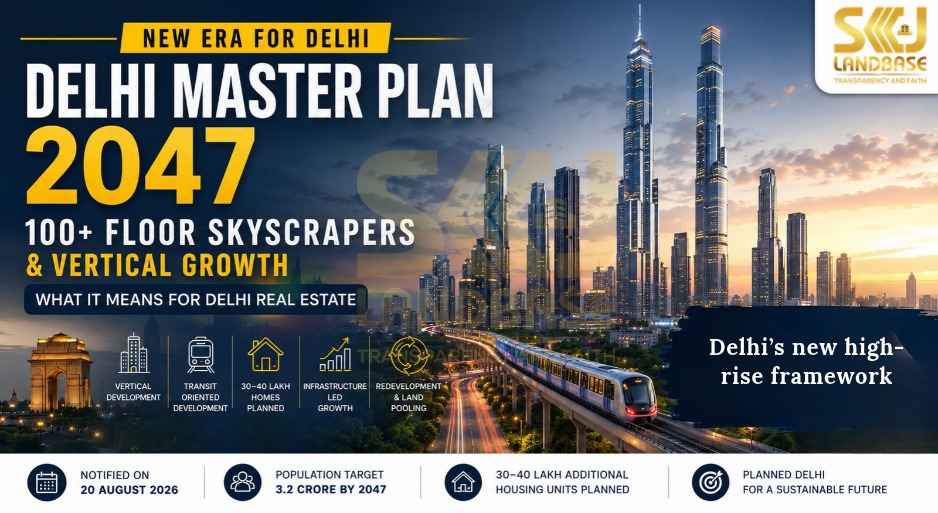
Delhi is preparing for a significant transformation in the way it grows.
The newly notified Master Plan for Delhi 2047 (MPD-2047) has opened the door to a more vertical, high-density model of urban development, including a framework for buildings that could potentially rise beyond 100 floors.
The plan, notified by the Union Ministry of Housing and Urban Affairs on August 20, 2026, represents a major shift in Delhi’s long-term approach to land use, housing, infrastructure and urban redevelopment.
For decades, Delhi’s development has been constrained by limited land availability, protected areas, low-density zones and its historic urban character. MPD-2047 attempts to address this pressure by encouraging densification, redevelopment, transit-oriented development and more efficient use of land.
For the real estate industry, this could mark the beginning of a new phase for Delhi.
What Is MPD-2047?
The Master Plan for Delhi 2047 is the city’s long-term framework for urban development through 2047.
The plan has been designed around the expected growth of Delhi’s population and the need for additional housing, transportation infrastructure, employment opportunities and public facilities.
According to the government, Delhi’s population is projected to reach approximately 3.2 crore by 2047, compared with an estimated 2.4 crore currently. To accommodate this growth, MPD-2047 targets approximately 30–40 lakh additional housing units over the next two decades, with an emphasis on affordable housing.
The plan proposes that this additional housing supply will come through a combination of:
- Redevelopment of existing neighbourhoods
- Densification
- Transit-oriented development
- Land pooling
- Planned expansion into new areas
- Better utilisation of underused land
This represents a fundamental change from simply expanding the city horizontally.
Delhi Opens the Door to 100+ Floor Buildings
One of the most significant elements of MPD-2047 is its explicit recognition of buildings exceeding 100 floors.
The plan categorises structures with more than 100 floors as “tall buildings” and considers them “landmark developments.”
However, this does not mean that 100-floor towers can be constructed anywhere in Delhi.
The plan envisages such developments in locations with adequate infrastructure, particularly around mass-transit corridors and major commercial and mixed-use centres.
The planning framework also requires these landmark buildings to respond to their surrounding urban context.
Delhi’s skyline will therefore need to evolve while taking into account:
- Historic landmarks
- Heritage areas
- Ceremonial avenues
- Important view corridors
- Existing urban character
In other words, the policy is not simply about building higher. It is about planned vertical growth.
Why Is Delhi Moving Towards Vertical Development?
The biggest constraint facing Delhi is simple: land is finite.
Delhi’s total geographical area is approximately 1,483 sq. km, while its population is expected to increase significantly over the coming decades. The government has therefore identified densification and efficient land utilisation as important components of future urban planning.
Instead of continuously expanding outward, the city can accommodate more residents and economic activity by using land more efficiently.
Vertical development can potentially allow:
More homes + better land utilisation + stronger public transport integration
provided that infrastructure develops alongside density.
This is particularly important for Delhi because adding housing without simultaneously upgrading roads, water supply, sewerage, electricity, public transport and social infrastructure could create additional pressure on the city.
MPD-2047 therefore links future housing development with infrastructure availability.
Transit-Oriented Development Could Become a Major Real Estate Driver
Another major feature of MPD-2047 is the emphasis on Transit-Oriented Development (TOD).
The plan envisages high-density mixed-use development within:
- 500 metres on either side of existing and planned Metro corridors
- 500-metre radius around RRTS, railway and high-speed rail nodes
This could significantly influence where future residential and commercial development takes place.
TOD essentially brings housing, offices, retail, entertainment and public facilities closer to mass transportation.
For residents, the objective is shorter commutes and lower dependence on private vehicles.
For real estate developers, transit connectivity can create opportunities for higher-density development and more efficient land use.
Delhi’s Metro Network Is Also Planned to Expand
The growth of high-density development will require a corresponding expansion of public transport.
Under MPD-2047, the Metro network is expected to reach approximately 695 km by 2047.
The plan also envisages expansion of public transportation, including buses and six new RRTS corridors.
This is particularly important because vertical development works best when large populations have efficient access to mass transportation.
A high-rise development without adequate connectivity can create congestion.
A high-rise development integrated with Metro, RRTS and other public transport can instead become part of a more efficient urban model.
What Does MPD-2047 Mean for Delhi’s Real Estate Market?
The implications for Delhi’s real estate market could be significant.
The combination of redevelopment, densification, land pooling, TOD and higher-density development could unlock development potential in locations where land availability has traditionally been limited.
1. More Housing Supply
The target of 30–40 lakh additional housing units represents a substantial potential increase in residential supply.
This could create opportunities across different segments, particularly affordable and mid-income housing.
2. Redevelopment Opportunities
Older and underutilised neighbourhoods could become important redevelopment zones.
Instead of expanding the city outward, existing urban land could be redeveloped with more efficient layouts and higher densities.
3. New Development Corridors
Transit corridors could become increasingly important for future residential and commercial development.
The proposed high-density development framework along transit infrastructure is likely to make connectivity an even more important consideration for property buyers and investors.
4. Greater Interest From Private Developers
A clearer long-term planning framework can give developers greater visibility when evaluating large-scale projects.
The real estate industry has already described MPD-2047 as an encouraging development because of its emphasis on planned development, infrastructure, land utilisation and mixed-use development.
Will Every Part of Delhi Allow Skyscrapers?
No.
This is an important distinction.
Although MPD-2047 opens the framework for vertical development and 100+ floor buildings, several areas remain subject to specific restrictions.
The plan retains restrictions covering areas including:
- Lutyens’ Bungalow Zone
- Civil Lines Bungalow Area
- Connaught Place and its extension
- Zone O
- Yamuna floodplain
- Ridge
- Land Pooling Areas
- Low Density Areas
- Areas restricted by the Archaeological Survey of India or National Monuments Authority
The plan also provides specific height provisions for plotted residential housing outside these special zones.
Therefore, the headline “Delhi can now build 100-floor towers” should not be interpreted as an unrestricted permission to construct skyscrapers anywhere in the capital.
Actual development will continue to depend on land use, zoning, infrastructure, approvals and applicable development controls.
What Does This Mean for Property Prices?
The impact on property prices will not be uniform across Delhi.
Some areas could benefit from improved development potential, infrastructure and connectivity, while others may remain constrained by heritage, environmental or low-density regulations.
Transit-linked locations could potentially become more attractive because of the relationship between density and connectivity.
However, increased housing supply could also create greater competition between projects.
For investors, the important question will therefore not simply be:
“Will Delhi property prices rise?”
Instead, it will be:
“Which locations are positioned to benefit from the new development framework?”
That distinction could become increasingly important over the next decade.
What Could MPD-2047 Mean for NCR — Including Gurgaon and Noida?
Delhi’s transformation cannot be viewed in isolation from the wider NCR real estate market.
Delhi, Gurugram and Noida are increasingly connected through employment, transportation, residential migration and commercial activity.
A major increase in Delhi’s housing supply could influence buyer preferences across NCR.
At the same time, improved transit infrastructure and new development opportunities could strengthen connections between Delhi and neighbouring markets.
For Gurugram, the development of Delhi’s transportation network and the expansion of regional connectivity could potentially strengthen the NCR’s integrated real estate ecosystem.
The effect, however, will depend on how quickly the policies translate into actual projects and infrastructure.
Expert Opinion: Sanjeev Singh, MD, SKJ Landbase

Sanjeev Singh, Managing Director of SKJ Landbase, views the notification of MPD-2047 as a potentially important milestone for Delhi-NCR’s real estate evolution.
“The notification of MPD-2047 represents a significant shift in the way Delhi can approach its future growth. The emphasis on vertical development, redevelopment and transit-oriented planning reflects the reality that land availability in the capital is limited while housing and infrastructure requirements continue to increase.
From a real estate perspective, the biggest opportunity may not simply be the possibility of 100-plus-floor buildings. The larger opportunity is the creation of better-planned, infrastructure-led development where housing, transportation, commercial activity and public infrastructure work together.
For buyers and investors, location will become even more important. Areas with strong connectivity, established infrastructure and the potential to benefit from redevelopment or transit-oriented development could attract greater attention. At the same time, investors should distinguish between policy potential and projects that have actually received the necessary approvals.
The impact of MPD-2047 will ultimately depend on execution. If infrastructure development keeps pace with higher density, the policy could contribute significantly to creating a more efficient and globally competitive Delhi-NCR real estate market.”
— Sanjeev Singh, Managing Director, SKJ Landbase
Why This Matters for Homebuyers and Investors
The significance of MPD-2047 extends beyond skyscrapers.
For homebuyers, the plan could gradually change the availability and location of housing across Delhi.
For investors, it introduces another factor to consider when evaluating long-term property opportunities: future development potential under the city’s planning framework.
The strongest opportunities are likely to emerge where several factors come together:
**Transit connectivity
- Infrastructure
- Development potential
- Employment
- Housing demand
- Planned urban growth**
This is why investors should look beyond a property’s current surroundings and consider how its wider neighbourhood could evolve over the next 10–20 years.
What Should Property Buyers Watch Now?
As MPD-2047 moves from policy to implementation, buyers and investors should monitor several developments.
1. Development Control Regulations
The master plan provides the framework, but individual projects will still need to comply with applicable development controls and approvals.
2. Transit Infrastructure
Metro and RRTS expansion could become increasingly important in determining the attractiveness of high-density corridors.
3. Redevelopment Policies
Older residential areas could become significant redevelopment opportunities.
4. Land Pooling
Planned expansion through land pooling could create new development zones.
5. Infrastructure Capacity
Higher density must be supported by adequate roads, water, sewerage, electricity and public transport.
The Bigger Picture: Delhi’s Skyline Is Changing
Delhi has traditionally been associated with a relatively low-rise urban form compared with cities such as Mumbai, Dubai or Singapore.
MPD-2047 signals that the capital is willing to explore a different model where vertical development becomes an important tool for managing population growth and land constraints.
But the success of this transition will depend on balance.
Delhi’s future skyline will have to accommodate more people while protecting its heritage, environment and public spaces.
That is why the master plan’s approach to tall buildings is particularly significant. It treats 100-plus-floor structures not merely as high-rise buildings, but as potential landmark developments that must contribute to the identity of Delhi’s skyline.
Conclusion
The notification of Master Plan Delhi 2047 could mark a new chapter for Delhi real estate.
The possibility of 100-plus-floor buildings is undoubtedly the most attention-grabbing element, but the deeper change lies in the plan’s broader approach to densification, redevelopment, transit-oriented development, land pooling and infrastructure-led growth.
With Delhi’s population projected to reach approximately 3.2 crore by 2047 and a target of 30–40 lakh additional housing units, the capital will need new ways to use its limited land more efficiently.
For the real estate industry, this creates a long-term development opportunity.
For homebuyers and investors, it creates a reason to pay closer attention to transit corridors, redevelopment zones, infrastructure expansion and emerging development centres.
The real test, however, will be implementation.
If policy, infrastructure and development move together, MPD-2047 could fundamentally reshape not only Delhi’s skyline but also the wider Delhi-NCR real estate market.
For expert guidance on Delhi-NCR real estate opportunities and emerging markets, connect with SKJ Landbase.
Source: Hindustan Times