Haryana’s New EV Charging Rule Could Revolutionize Real Estate and Electric Mobility Across the State
The future of transportation is electric, and Haryana has decided to move ahead of the curve. In a landmark policy decision, the Haryana Town and Country Planning Department has amended the Haryana Building Code (HBC)-2017 and made electric vehicle (EV) charging infrastructure mandatory in new residential and commercial developments.
The move comes at a crucial time when electric vehicle adoption is growing rapidly across India. Cities such as Gurugram, Faridabad, Panchkula, Sonipat, and Karnal have witnessed a steady rise in EV ownership over the past few years. However, charging infrastructure has often struggled to keep pace with this growth.
Now, Haryana aims to bridge that gap. The new regulations will ensure that future buildings are equipped to support the growing number of electric vehicles on the road. As a result, residents, businesses, and developers will all benefit from a more organized and future-ready urban ecosystem.
Haryana Strengthens Its Push Towards Electric Mobility
Electric vehicles offer numerous advantages. They reduce pollution, lower fuel expenses, and contribute to a cleaner environment. However, convenient charging infrastructure remains one of the biggest concerns for potential EV buyers.
Recognizing this challenge, Haryana has introduced mandatory EV charging provisions in both residential and commercial developments. Instead of relying on retrofitting projects later, the government now wants charging infrastructure to become a standard feature during construction itself.
Consequently, future developments will better accommodate the transportation needs of modern residents and businesses.
Moreover, this decision aligns with India’s broader vision of promoting sustainable mobility and reducing carbon emissions.
What the Revised Haryana Building Code Says
The amended building code introduces specific requirements for different categories of projects.
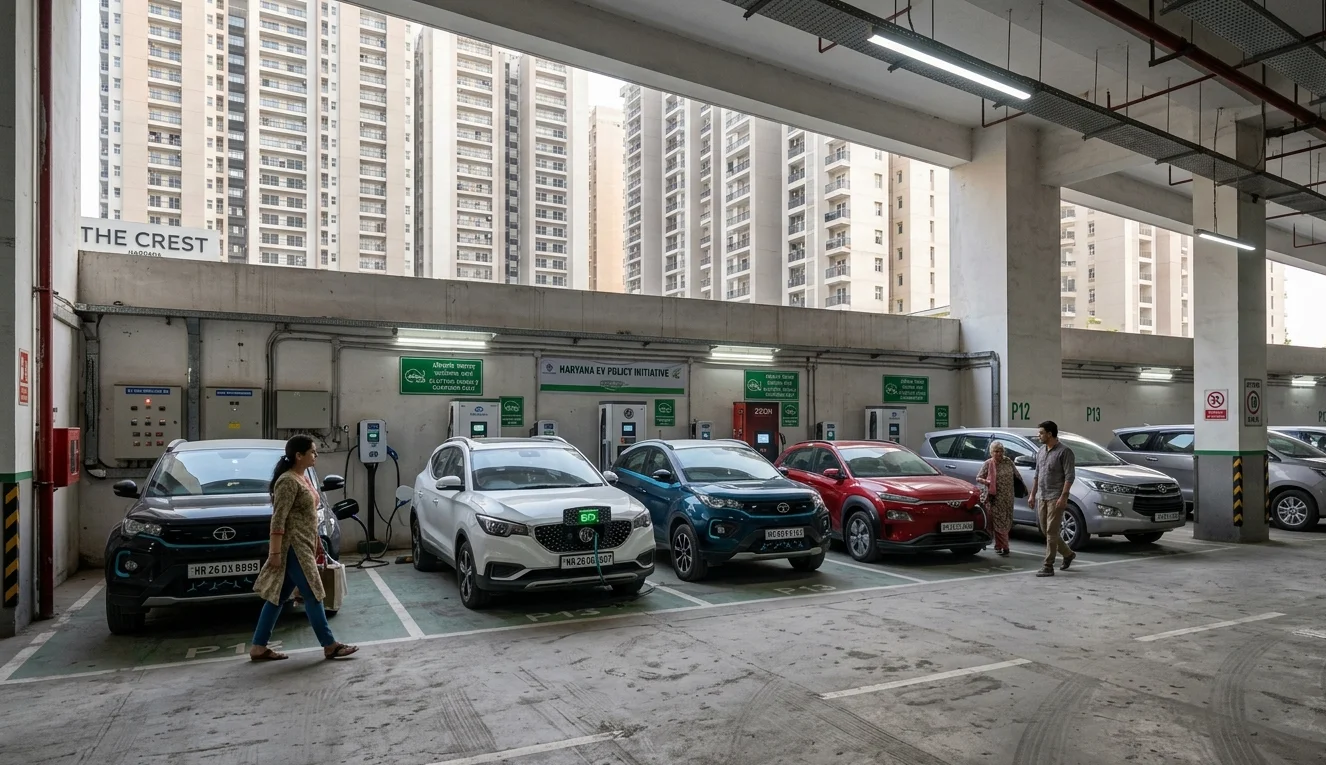
For residential developments, including group housing societies, cooperative housing projects, and residential complexes managed by Resident Welfare Associations (RWAs), developers must provide one EV charging spot for every five parking spaces.
The rules apply wherever parking facilities accommodate at least ten vehicles.
Additionally, all parking areas must include the required electrical infrastructure and conduits necessary to support EV charging facilities in the future.
The regulations become even stricter for commercial developments.
Properties such as:
- Shopping malls
- Hotels
- Office complexes
- Commercial centers
- Mixed-use projects
must provide one EV charging station for every three parking spaces where parking capacity exceeds ten vehicles.
Furthermore, developers must ensure that every parking slot remains EV-ready, enabling future upgrades without major structural modifications.
EV Charging Stations Now Allowed in Basements and Stilt Parking
One of the most important aspects of the amendment involves basement and stilt parking areas.
Earlier this year, many housing societies faced uncertainty regarding the installation of EV charging points in basement parking zones. Several Resident Welfare Associations reported concerns related to fire safety compliance and Fire NOC approvals.
This confusion created difficulties for EV owners and discouraged some residents from installing charging facilities.
The revised code addresses those concerns directly.
Under the new regulations, EV charging stations can be installed in basement and stilt parking areas. However, developers and societies must comply with prescribed fire safety and electrical safety standards.
In addition, the Fire Department must certify these installations before they become operational.
This clarification provides much-needed confidence to both residents and developers.
The Controversy That Triggered the Need for Clear Guidelines
The amendment arrives shortly after a major controversy involving EV chargers in Gurugram’s high-rise societies.
Earlier, the Haryana Fire Department raised concerns regarding basement charging facilities and their impact on fire safety norms. As reports spread, several RWAs asked residents to remove charging points to avoid complications during Fire NOC renewals.
Industry estimates suggested that hundreds of housing societies faced uncertainty due to the lack of clear guidelines.
Although authorities later clarified that EV chargers alone would not lead to Fire NOC rejection, confusion continued among residents.
Now, the new amendment removes ambiguity and establishes a clear legal framework for charging infrastructure installation.
As a result, stakeholders finally have clarity regarding compliance requirements.
A Significant Boost for Sustainable Urban Development
The benefits of this policy extend far beyond vehicle charging.
First, it supports Haryana’s efforts to create cleaner and greener cities. When charging infrastructure becomes readily available, more people feel comfortable switching from conventional vehicles to electric alternatives.
Second, widespread EV adoption can significantly reduce urban air pollution.
Third, integrated charging infrastructure helps cities prepare for future transportation demands.
Some of the key long-term benefits include:
- Reduced carbon emissions.
- Lower dependence on fossil fuels.
- Improved air quality.
- Better energy efficiency.
- Increased adoption of electric mobility.
- Future-ready urban infrastructure.
Therefore, the policy contributes to both environmental sustainability and economic progress.
Positive Impact on Haryana’s Real Estate Sector
The real estate industry is likely to emerge as one of the biggest beneficiaries of this policy.
Today’s homebuyers increasingly seek projects that offer smart and sustainable amenities. EV charging infrastructure has quickly become one of those desirable features.
Properties equipped with charging facilities often attract greater buyer interest because they align with future lifestyle requirements.
Moreover, Haryana has introduced a developer-friendly incentive.
The amended rules exempt EV charging infrastructure from Floor Area Ratio (FAR) calculations. Consequently, builders can install charging facilities without affecting their permissible built-up area.
This provision makes compliance easier while encouraging widespread implementation.
Developers can now market their projects as future-ready communities without sacrificing development potential.
Existing Residential Societies Also Receive Relief
The benefits of the amendment do not stop with new developments.
Existing apartment owners and allottees can also install EV charging facilities in their designated parking spaces.
However, they must secure the necessary approvals related to:
- Electrical safety.
- Fire safety compliance.
- Power distribution requirements.
This provision offers flexibility to current EV owners and supports the gradual expansion of charging infrastructure across older residential communities.
Consequently, Haryana’s EV ecosystem will continue growing beyond newly launched projects.
Expert View by Sanjeev Singh

Sanjeev Singh, MD, SKJ Landbase, believes the amendment represents a transformative step for Haryana’s urban development landscape.
According to him, future homebuyers will increasingly prioritize projects that offer sustainable and technology-driven infrastructure. He notes that mandatory EV charging provisions will strengthen buyer confidence, improve property values, and enhance the appeal of emerging investment destinations such as Dwarka Expressway, New Gurugram, SPR, and Sohna.
He also believes that the policy positions Haryana as a forward-thinking state that understands the future needs of both residents and investors.
Conclusion
Haryana’s decision to mandate EV charging infrastructure in new residential and commercial developments marks a significant milestone in the state’s journey toward sustainable urban growth.
The policy not only addresses the growing demand for charging facilities but also removes uncertainty surrounding installation guidelines. At the same time, it encourages cleaner transportation, supports environmental goals, and creates future-ready communities.
As electric vehicles become increasingly common on Indian roads, charging infrastructure will become as essential as parking spaces, elevators, and power backup systems.
Through this bold initiative, Haryana has taken an important step toward building smarter cities, promoting green mobility, and preparing its urban landscape for the next generation of transportation.