AI Is Transforming India’s Budget Hospitality Sector
India’s hospitality industry is entering a new technology-driven phase. Artificial intelligence now plays a growing role in hotel operations, guest experience, and expansion strategies. Embassy Group’s Olive Hospitality stands at the center of this transformation.
The company recently announced an ambitious expansion plan. Olive Hospitality aims to scale its portfolio to 10,000 hotel keys within the next financial year. This growth will largely come through Open Hotels, the company’s AI-integrated hospitality vertical.
This move reflects a broader shift across the hospitality industry. Hotels increasingly rely on digital platforms, automation, and AI-driven systems to manage operations more efficiently. Consequently, companies like Olive Hospitality now expand faster while maintaining operational consistency across locations.
At present, Olive Hospitality operates 112 properties with 4,615 keys across its brands. However, the company plans to more than double this number through a technology-first expansion model.
Open Hotels: The AI-Powered Hotel Model
Open Hotels represents Olive Hospitality’s most innovative concept. Unlike traditional hotel models, Open Hotels integrates agentic AI systems that manage many daily operational tasks.
This AI layer functions almost like a digital general manager. It oversees several important functions including pricing, guest interactions, security monitoring, reputation management, and operational coordination.
As a result, hotel staff can focus more on customer experience rather than repetitive administrative tasks.
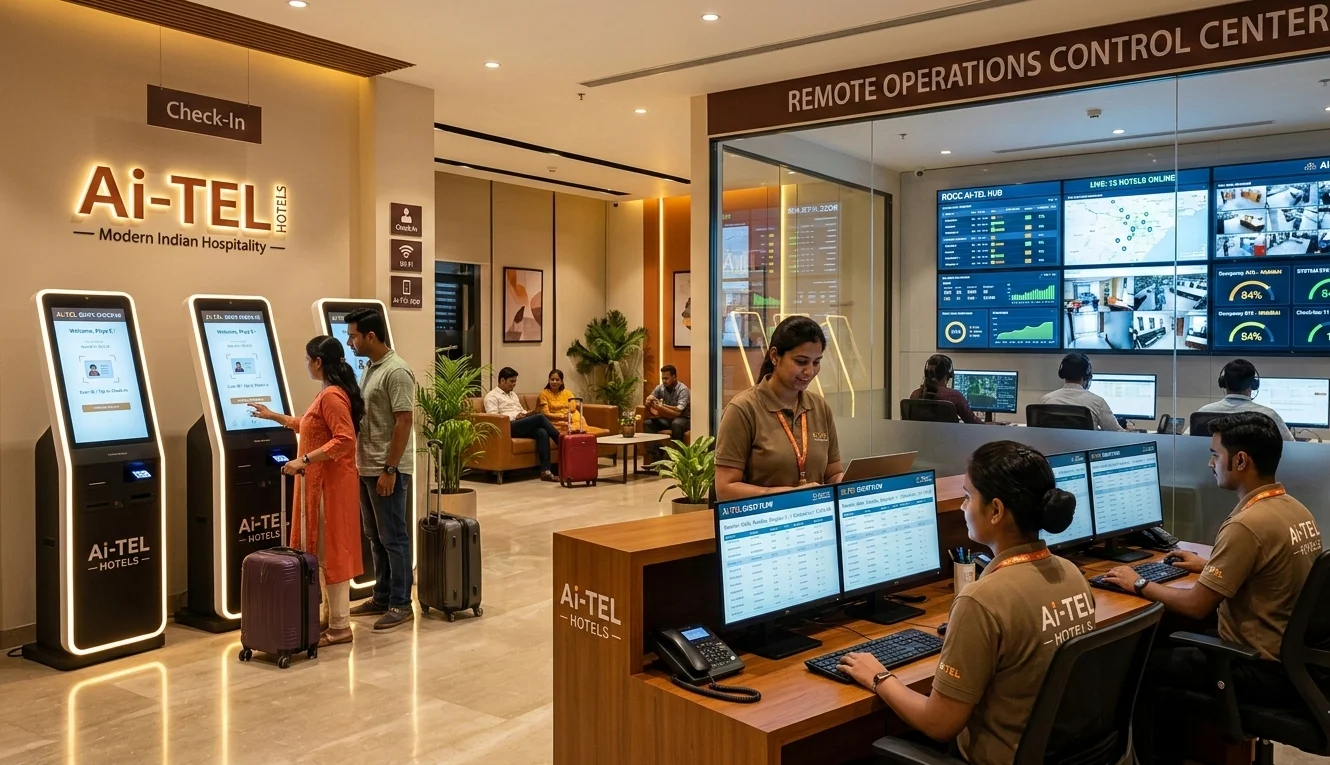
Even more importantly, the system enables centralised hotel operations. A single front office executive can now manage check-ins across multiple hotel locations from one control center.
For example, a staff member can check in a guest at a hotel in Goa and then immediately process another guest arriving in Vijayawada. This technology eliminates the need for full front desk teams at every property.
Consequently, the AI-driven model significantly improves operational efficiency while reducing costs.
Centralised Operations Changing Hotel Management
The centralised management model has begun reshaping how hotels operate.
Instead of placing large staff teams at each hotel property, Olive Hospitality uses Grade A office-based operations centers. Employees monitor multiple hotels through digital dashboards and remote systems.
This setup makes the job role closer to an IT operations position than traditional hotel management.
Additionally, widespread adoption of UPI payments and digital transactions in India has made AI-enabled check-ins easier for guests. Many travelers now feel comfortable completing automated or AI-assisted check-ins, especially during late-night arrivals.
In some smaller hotels, AI can even operate the property 24 hours a day with minimal staff involvement. Meanwhile, larger hotels continue to use staff support during peak hours while AI manages overnight operations.
Therefore, this hybrid human-AI model offers both efficiency and service reliability.
Faster Expansion Through Technology Integration
One of the biggest advantages of the Open Hotels model lies in its speed of expansion.
Traditional hotel development often requires heavy investment and long timelines. Building a hotel from scratch can take 18 to 36 months. Even converting an existing property typically takes six to twelve months.
However, Open Hotels follows a completely different strategy.
Instead of constructing new buildings, Olive Hospitality onboards existing hotel properties and integrates them with its AI technology platform. The company standardizes operations digitally rather than through major physical renovations.
Because of this approach, a new property can become operational in as little as three weeks.
This speed allows the company to expand across multiple cities rapidly while keeping costs under control.
Growing Presence Across Indian Cities
Open Hotels already operates in several Indian cities. These include Bengaluru, Hyderabad, Vijayawada, Chikkamagaluru, Visakhapatnam, and Murudeshwar.
At present, Open Hotels manages 30 properties with 827 keys. However, this segment currently accounts for 18% of Olive Hospitality’s portfolio and continues to grow rapidly.
Meanwhile, the company’s broader hospitality portfolio includes three key brands:
- Olive Hotels: 73 properties with 3,124 keys
- Spark by Hilton: 9 properties with 664 keys
- Open Hotels: 30 properties with 827 keys
Room pricing also varies across these brands.
Olive Hotels and Open Hotels primarily operate in the ₹2,000 to ₹4,000 per night range, catering to budget and mid-scale travelers. On the other hand, Spark by Hilton targets a more premium segment with room tariffs between ₹4,000 and ₹8,000.
This diversified pricing strategy allows the company to attract both business travelers and leisure guests.
Expansion Into Northern Markets
While Olive Hospitality already maintains a strong presence in southern India, the company has now started expanding into northern markets as well.
In fact, the company recently entered the National Capital Region (NCR) by signing a new Olive Hotels property in Gurugram.
This move signals the company’s broader plan to expand across major metropolitan hubs and business corridors in India.
Cities like Gurugram offer strong potential because they combine corporate demand, startup activity, and growing tourism infrastructure.
As AI-driven hospitality continues to grow, technology-enabled hotel models may soon become common across such urban markets.
Industry Perspective

According to Sanjeev Singh, Managing Director of SKJ Landbase, technology-led hospitality models will reshape the future of the hotel sector.
He explains, “AI-powered hotel operations represent a major shift for the hospitality industry. Technology now allows companies to scale faster, optimise staffing, and deliver consistent guest experiences across multiple locations. As cities like Gurugram continue to grow as business hubs, AI-integrated hospitality platforms will become an important part of the urban accommodation ecosystem.”
His observation highlights a broader trend. As digital infrastructure improves across India, hospitality companies increasingly adopt automation, data analytics, and AI tools to stay competitive.
The Future of AI in Hospitality
The hospitality industry has always relied on service quality and operational efficiency. However, the rise of artificial intelligence now introduces a completely new dimension.
AI platforms can monitor guest feedback, adjust pricing dynamically, optimize staffing, and even predict demand patterns.
For companies like Olive Hospitality, these technologies unlock the ability to expand rapidly without compromising service standards.
As a result, the target of 10,000 keys within the next year looks increasingly achievable.
More importantly, this model may set a new benchmark for technology-driven hospitality growth in India.
The coming years will likely witness many more hotel brands adopting AI-led operations, transforming how hotels operate across the country.