
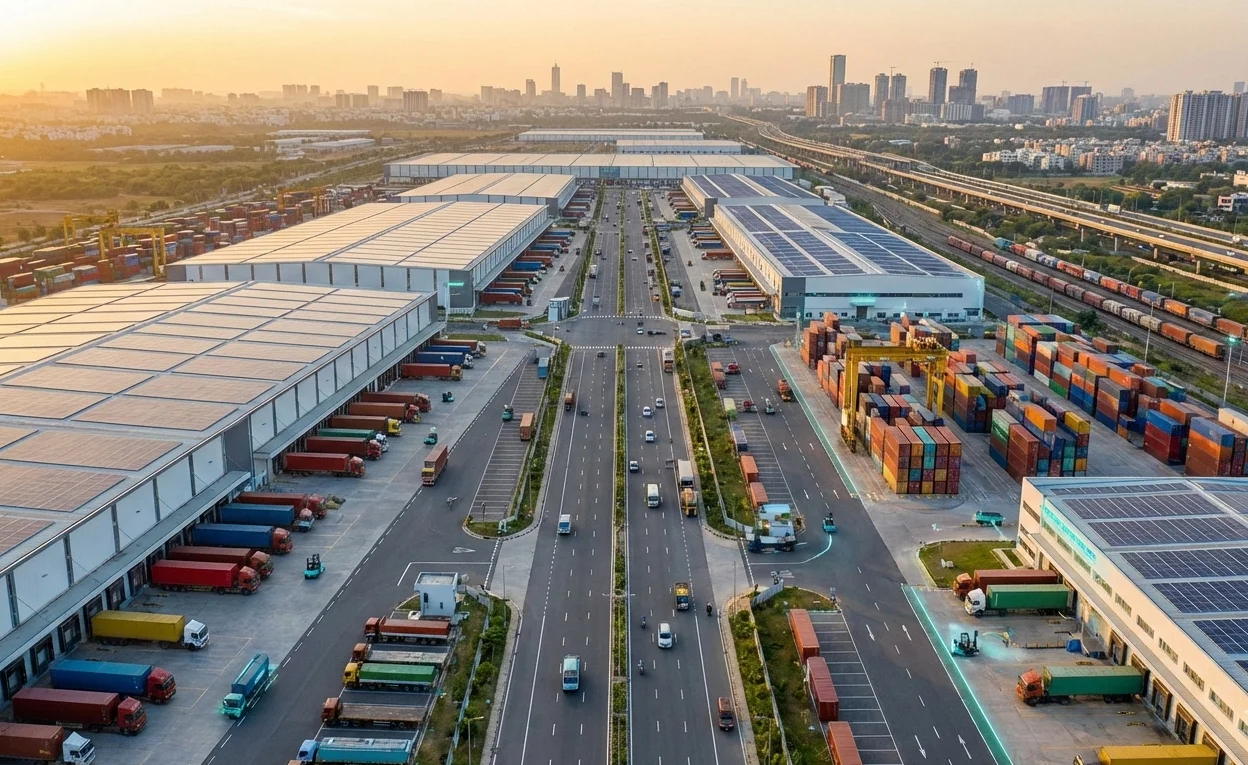
India’s Warehousing Boom: Why 610 Million Sq Ft. Is Just the Beginning
India’s logistics and warehousing sector has reached a historic milestone. Total warehousing stock has crossed 610 million sq ft in 2025, and the momentum continues to build. Even more importantly, industry projections suggest the sector will reach 850 million sq ft by 2030. This growth signals a powerful shift in how India stores, moves, and delivers goods.
Let’s explore what is driving this transformation and why it matters for businesses, investors, and the real estate ecosystem.
India’s Warehousing Sector Hits a Landmark Moment
India’s consumption story continues to expand rapidly. As a result, the logistics backbone must evolve at the same pace. Warehousing now plays a central role in supporting e-commerce, manufacturing, and fast delivery expectations.
The top eight Tier I markets dominate the sector. These include Delhi NCR, Mumbai, Pune, Bengaluru, Chennai, Hyderabad, Ahmedabad, and Kolkata. Together, these cities hold 82% of India’s warehousing stock, which equals 498 million sq ft.
This concentration makes sense. Tier I cities offer better infrastructure, stronger connectivity, and proximity to major consumption hubs. However, the story does not end here. A new growth wave has already started beyond metro cities.
Tier II Cities Are Quietly Gaining Momentum
While Tier I cities continue to lead, Tier II cities now attract serious attention. Cities like Lucknow, Chandigarh–Rajpura, Kochi, and Nagpur are witnessing strong warehousing traction.
Currently, 14 emerging Tier II cities hold 112 million sq ft of stock. Moreover, they recorded 12 million sq ft of absorption in 2025 alone. This shift signals a major change in logistics strategies.
Companies no longer want supply chains concentrated in just a few metro locations. Instead, they now prefer distributed logistics networks. This strategy helps them deliver faster, reduce costs, and build resilience.
Several factors drive this shift:
- Improving infrastructure
- Lower land costs
- Rising consumption in smaller cities
- Expansion of highways and freight corridors
Consequently, Tier II cities have moved from “future potential” to present opportunity.
Demand Drivers: E-commerce and 3PL Lead the Charge
India’s digital economy has reshaped consumer behaviour. People expect faster deliveries, wider product choices, and seamless service. Naturally, this demand pushes logistics companies to expand storage capacity.
Third-party logistics (3PL) and e-commerce companies now lead warehousing demand. They need large spaces, modern facilities, and strategic locations.
At the same time, light manufacturing continues to grow. Industries such as automotive, engineering, and electronics require efficient storage and distribution networks. This shift reflects a broader transformation in occupier profiles.
Warehousing no longer serves only storage needs. Today, facilities act as integrated supply chain hubs.
The Rise of Grade A Warehousing
Quality now matters more than ever. Businesses demand world-class infrastructure, safety standards, and efficiency. As a result, Grade A facilities now make up 53% of India’s total warehousing stock.
Institutional investors also play a crucial role. They now account for 38% of quality stock. Their involvement brings standardized development, advanced specifications, and global best practices.
This change attracts multinational companies and global occupiers. It also increases transparency and professionalism in the sector.
In short, warehousing has moved from basic storage spaces to premium logistics assets.
Automation Is Transforming Warehousing Forever
Technology now reshapes every part of logistics. Warehouses no longer rely heavily on manual processes. Instead, automation drives efficiency, speed, and accuracy.
Industry estimates show automation adoption may rise from 10% in 2025 to nearly 76% by 2030. This transformation includes:
- Robotics and automated sorting
- AI-driven inventory systems
- Smart warehouse management software
- Space optimization technologies
Companies view automation as a strategic investment. Most projects recover costs within two to three years. Therefore, businesses increasingly adopt automation to stay competitive.
Soon, warehouses will function as smart fulfillment hubs rather than storage buildings.
India’s Road to 850 Million Sq Ft by 2030
The sector expects 28% growth over the next five years. India will likely add 240 million sq ft of warehousing stock by 2030.
Several megatrends support this growth:
- Expansion of national highways and freight corridors
- Rise of quick commerce and same-day delivery
- Growth in domestic manufacturing
- Increasing institutional investments
- Focus on resilient supply chains
Together, these factors position India as a future global logistics powerhouse.
Why This Matters for Real Estate and Investors

Sanjeev Singh, MD of SKJ Landbase, shares his perspective:
“India’s warehousing growth reflects the country’s economic transformation. Logistics infrastructure now drives business efficiency and investment confidence. As automation and Tier II expansion accelerate, warehousing will become one of the strongest pillars of India’s real estate and industrial growth story.”
His statement highlights the sector’s long-term potential and growing investor interest.
The Future: Smart, Sustainable, and Strategic
India’s warehousing future looks smarter and more sustainable. Developers now focus on:
- Green building certifications
- Solar power adoption
- Energy-efficient designs
- ESG-driven investments
Sustainability will soon become a core requirement rather than an optional feature.
Moreover, the sector will witness the convergence of technology, geography, and institutional capital. This combination will transform logistics into a highly efficient ecosystem.
Final Thoughts
India’s warehousing sector has entered a new era. The country has already crossed 610 million sq ft, and the journey toward 850 million sq ft has begun.
Tier I cities still lead the market. However, Tier II cities now drive the next growth wave. Automation continues to redefine operations. Institutional investors strengthen the ecosystem.
All signs point toward a future where India stands among the world’s top logistics hubs. And clearly, this warehousing boom has only just started


