Ghaziabad–Jewar RRTS Corridor: Transforming Airport Travel in NCR
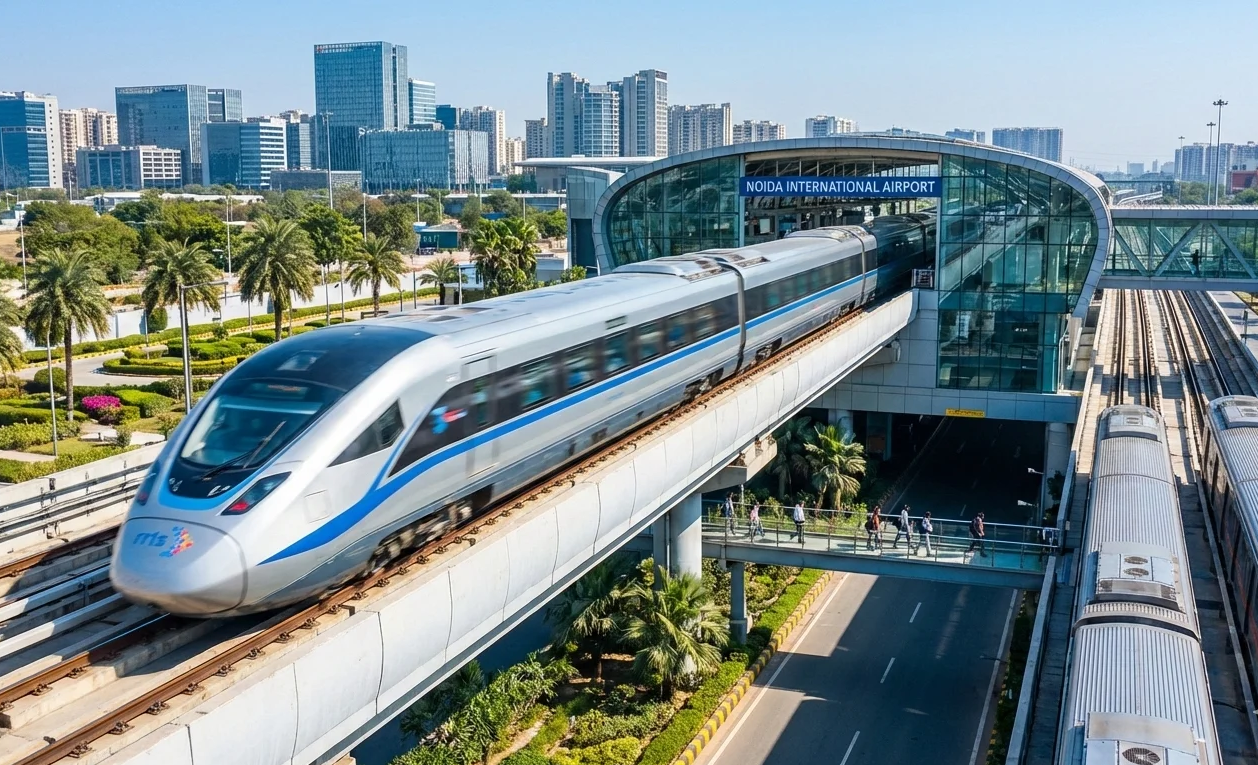
The National Capital Region (NCR) is on the verge of a massive transport upgrade. The Uttar Pradesh government, along with key agencies, has prioritized the Ghaziabad–Jewar Regional Rapid Transit System (RRTS) corridor. This 72-km high-speed rail link will connect Ghaziabad to the upcoming Noida International Airport (Jewar) via Greater Noida West.
YEIDA officials describe this project as more than just a transit line. It is set to redefine airport connectivity for millions of residents and travelers in NCR. “The Ghaziabad–Jewar RRTS corridor will serve as the backbone of airport connectivity for Ghaziabad, Noida, Greater Noida West, and YEIDA-notified areas,” said Shailendra Bhatia, Additional CEO, YEIDA.
Twin Corridors: Faster Access to Airports
Excitingly, Noida International Airport will enjoy connectivity through two rapid rail corridors.
Apart from the Ghaziabad–Jewar corridor, a 60-km RRTS link from IFFCO Chowk in Gurugram to Surajpur via Faridabad has been proposed. This corridor will connect key NCR pockets to Delhi’s IGI Airport, providing faster access from Gurugram, Faridabad, and Greater Noida.
“These corridors complement each other rather than compete. Surajpur will emerge as a key interchange node in NCR’s future high-speed rail network,” added Bhatia.
The twin-corridor approach promises balanced regional mobility and will ease pressure on roads, making airport travel faster and more convenient for passengers.
Corridor Design and Features
The Ghaziabad–Jewar corridor is planned as an elevated RRTS-cum-metro line, spanning 72.44 km, including a 1.1-km underground stretch at the airport. Key features include:
- 22 stations: 11 integrated RRTS-cum-metro stations and 11 metro-only stations.
- Space for 12 future stations to support expansion.
- Seamless multimodal connectivity at Ghaziabad, linking with the Delhi–Meerut RRTS, Red Line Metro, and Aqua Line extension.
The alignment runs from Siddharth Vihar (Ghaziabad) through Char Murti Chowk, Knowledge Park-5, Police Lines, Surajpur, Alpha-1, and Yamuna City sectors 18 and 21, ending at Noida International Airport.
“The multimodal integration ensures passengers can switch easily between metro, RRTS, and future transit options,” explained Bhatia.
Faster Travel, Reduced Commute
Once operational, the corridor will cut travel time dramatically.The National Capital Region Transport Corporation (NCRTC) estimates a 60–70-minute reduction, depending on the route.
The Gurugram–Faridabad–Surajpur corridor will act as a major feeder for IGI Airport, connecting passengers from multiple NCR cities efficiently.
Expert Advice

Sanjeev Singh, MD of SKJ Landbase, highlighted the broader impact:
“Improved airport connectivity via RRTS corridors will boost property demand in Ghaziabad, Noida, and Greater Noida West. Developers should focus on transit-oriented projects to maximize long-term growth potential.”
Clearly, the project will reshape real estate patterns, providing opportunities for residential and commercial growth along the corridors.
Multi-Modal Connectivity: More Than Just Rail
The UP government’s vision goes beyond a single mode of transport. Officials aim to integrate metro lines, bus rapid transit, and future smart transport systems.
YEIDA has also proposed a Jewar–Sarai Kale Khan rapid rail project, which is awaiting approval. If it materializes, NCR residents will enjoy multiple rapid transit options for airport access.
This multi-modal approach ensures passengers don’t rely solely on roadways, reducing traffic congestion and travel stress. It also supports sustainable and efficient transport solutions, making NCR cities future-ready.
Economic, Urban, and Real Estate Impact
The twin corridors are more than just infrastructure projects they promise significant economic benefits:
- Boosting real estate values around key stations.
- Encouraging commercial development along transit routes.
- Reducing traffic congestion and pollution.
- Promoting sustainable urban growth through smart planning.
The RRTS corridors will not only make travel convenient but also attract investments. Offices, hotels, and retail hubs near stations will benefit from high passenger footfall. This will create job opportunities and stimulate regional economic growth.
The Future of Airport Travel
With Noida International Airport expected to handle massive passenger volumes in the coming years, the Ghaziabad–Jewar RRTS corridor, together with the Gurugram–Faridabad–Surajpur link, will become vital arteries for NCR mobility.
Residents of Ghaziabad, Noida, and Greater Noida West will enjoy direct, high-speed access to the airport. Travelers from IGI Airport will also benefit from faster connections via Surajpur, making the twin corridors strategic game-changers for NCR’s transport landscape.
The corridors are a visionary step, blending speed, efficiency, and connectivity. For NCR residents, business travelers, and tourists, the future of airport travel is faster, easier, and smarter than ever.