HSPCB Orders Smog Guns in 193 High-Rise Societies Across Gurugram
Gurugram’s winter air quality continues to raise concern. Every year, pollution levels spike as temperatures drop. This time, the Haryana State Pollution Control Board (HSPCB) has moved quickly. It has directed 193 high-rise residential societies to deploy smog guns or high-pressure water sprinkling systems.
The advisory, issued on December 26, focuses on cutting PM2.5 and PM10 levels. These fine particles pose serious health risks. They enter deep into the lungs. trigger breathing disorders. They also increase long-term exposure risks for children and senior citizens. Therefore, HSPCB now expects residential communities to play a direct role in pollution control.
Why High-Rise Residential Clusters Matter
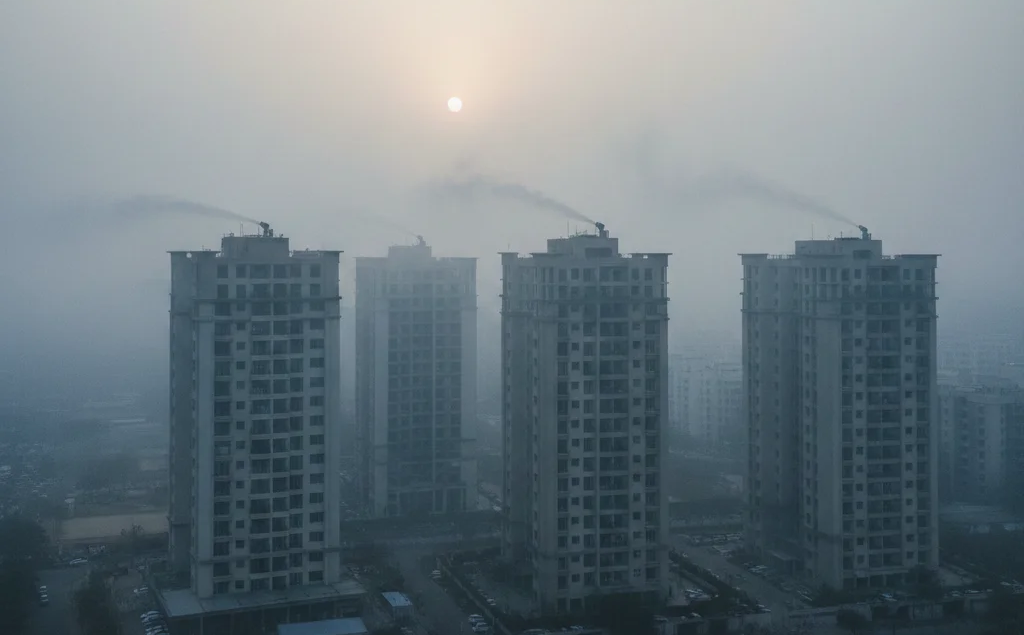
High-rise societies contribute significantly to localised air pollution. Daily vehicle movement inside complexes resuspends settled dust. Ongoing construction work adds more particulate matter. Open parking areas and uncovered roads worsen the situation.
In addition, tall buildings restrict air circulation. During winter, low wind speed and temperature inversion trap pollutants close to the ground. As a result, air quality deteriorates faster and improves slower.
Because of these factors, HSPCB has identified high-rise clusters as critical intervention points. The goal remains simple. Reduce dust at the source. Protect residents where they live.
How Smog Guns and Sprinklers Improve Air Quality
Smog guns release fine water mist into the air. These droplets bind with dust particles. As a result, heavier particles settle quickly instead of floating. High-pressure sprinklers achieve a similar effect on roads and open surfaces.
HSPCB has instructed societies to install these systems on rooftops or topmost levels. Elevated placement ensures wider dispersion. It also improves coverage across internal roads, parking zones, common areas, and periphery spaces.
Authorities have also specified early morning and evening operations. These time slots align with peak pollution hours. Societies must increase usage whenever air quality slips into poor, very poor, severe, or severe-plus categories.
Key Compliance Guidelines for RWAs
HSPCB has issued clear operational instructions. Societies must use treated water from sewage treatment plants wherever possible. This step prevents wastage of potable water. It also promotes sustainable resource use.
Directional nozzles must prevent waterlogging. Proper elevation must avoid inconvenience to residents. At the same time, sprinklers should cover maximum dust-prone zones.
Moreover, RWAs must nominate a responsible member. This person will oversee daily operations. They will also maintain a logbook. The logbook must record timings and duration of smog gun usage. Officials may inspect these records during compliance checks.
Although the advisory does not mention penalties, it clearly links operations to GRAP-triggered pollution phases. Therefore, societies must stay alert during high-pollution episodes.
Smog Guns Alone Will Not Solve Everything
HSPCB has stressed one important point. Smog guns act as a short-term mitigation tool, not a permanent solution. Therefore, societies must adopt additional measures.
Regular wet sweeping of internal roads remains mandatory. Waste burning must stop completely. Construction material must stay covered at all times. Green buffers must increase wherever possible. Diesel generator usage must remain regulated and minimal.
When societies implement these steps together, local air quality improves faster. Community participation becomes the real catalyst.
Expert Insight: Sanjeev Singh, MD, SKJ Landbase

Sanjeev Singh, Managing Director of SKJ Landbase, believes the directive marks an important shift toward decentralised responsibility.
Air pollution cannot be controlled by enforcement alone. Residential societies now play a critical role in reducing local dust emissions. Smog guns and rooftop sprinklers offer an immediate relief during peak pollution phases. However, long-term improvement will depend on disciplined community behaviour, better construction practices, and sustainable urban planning. This advisory pushes cities in the right direction.
His view highlights a crucial reality. Technology helps. Awareness sustains.
Gurugram’s Bigger Air Quality Challenge
Gurugram frequently ranks among cities with poor winter air quality. Rapid urbanisation has intensified the challenge. Infrastructure growth, vehicle density, and construction activity continue to rise.
Because of this, authorities now favour decentralised mitigation. Instead of relying only on mobile smog guns, fixed high-pressure sprinklers inside residential clusters reduce emissions without adding vehicle pollution.
Experts agree that such interventions work best during episodic spikes. At the same time, cities must focus on emission reduction at the source for lasting results.
Final Thoughts
HSPCB’s directive sends a clear message. Clean air requires collective action. High-rise societies can no longer remain passive observers. They must become active participants.
When RWAs, residents, and authorities work together, results follow. Smog guns may not solve everything. However, they can reduce immediate exposure. They can protect vulnerable populations. Most importantly, they can build momentum toward cleaner, healthier urban living.