India’s retail real estate market is witnessing a strong comeback.
After facing supply shortages and delayed expansions for nearly two years, the sector is now regaining momentum. According to the Cushman & Wakefield India Outlook 2026 report, retail leasing is expected to cross 9 million square feet by the end of 2025. This number marks the highest absorption level since the pandemic.
More importantly, this growth reflects renewed confidence in India’s consumption story.
Strong Supply Push Revives Leasing Activity
The biggest trigger behind this surge is improved mall supply.
In 2024, developers delivered only 0.9 million sq ft of Grade A mall space. As a result, several retailers postponed expansion plans due to lack of quality options.
However, 2025 presents a different picture.
Developers are on track to complete around 4.3 million sq ft of Grade A malls during the year. Consequently, retailers are finally finding suitable spaces in prime locations.
This improvement has unlocked pent-up demand. Retailers that waited patiently are now moving quickly. As a result, malls are regaining their share in overall leasing activity.
Malls Regain Ground from High Streets
High streets have continued to perform well. Yet, malls are now catching up faster.
Earlier delays occurred due to limited availability of organised retail assets. Now, new completions are providing much-needed breathing space.
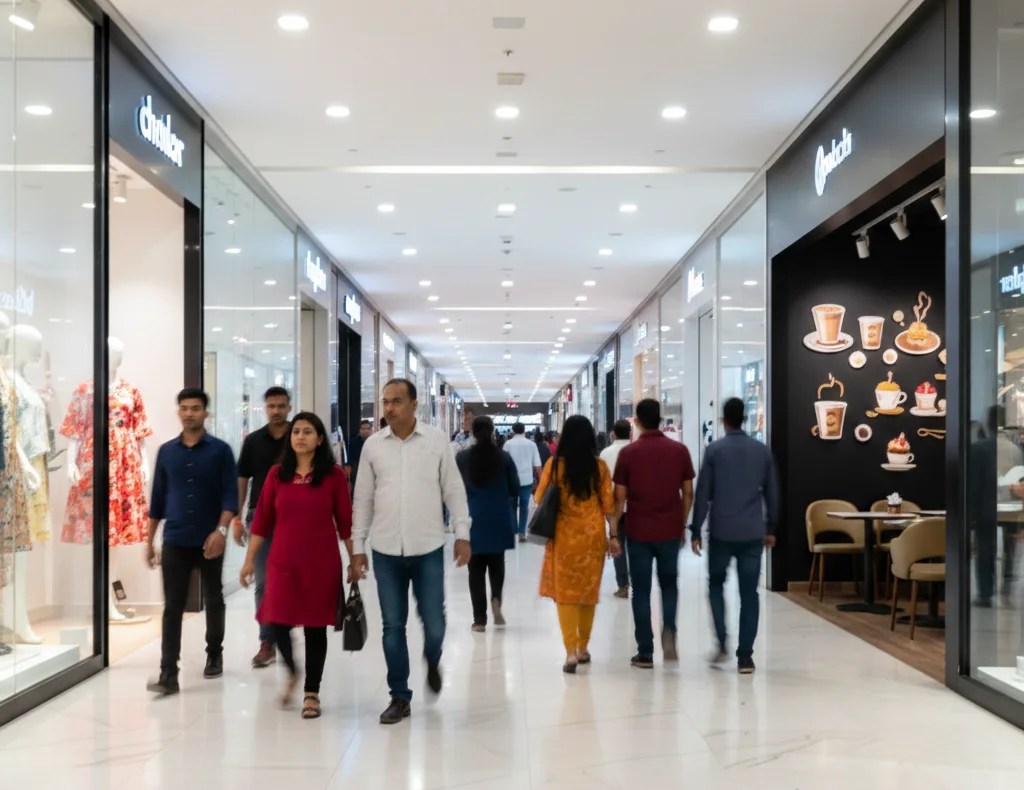
Malls offer better infrastructure, efficient zoning, and consistent footfall. Additionally, they allow retailers to build stronger brand experiences. Because of these advantages, leasing momentum has shifted back toward organised retail formats.
This shift has helped stabilise the retail ecosystem across major cities.
Fashion, F&B, and Entertainment Drive Demand
Demand remains broad-based but focused.
Fashion and lifestyle brands continue to lead leasing activity. These brands are expanding aggressively to tap rising urban consumption.
At the same time, food and beverage outlets are scaling up. Cafés, QSRs, and casual dining brands are becoming anchors rather than add-ons. Consumers now view dining as an experience, not just a transaction.
Entertainment also plays a critical role. Multiplexes and family entertainment zones are increasing dwell time and boosting mall footfalls. Together, these segments form the core demand drivers for 2025.
Leasing Jumps from 7.8 MSF to 9 MSF
The numbers highlight the turnaround clearly.
Retail leasing stood at 7.8 million sq ft in 2024. By the end of 2025, absorption is expected to cross 9 million sq ft.
This growth did not happen overnight.
Improved supply conditions allowed retailers to execute long-pending plans. Moreover, several Grade A malls became operational in the final quarter, leading to a strong year-end surge.
As a result, organised retail has regained momentum after two years of constrained growth.
Expert Insight: Sanjeev Singh, MD, SKJ Landbase

Sanjeev Singh, Managing Director at SKJ Landbase, believes this phase marks a structural shift in retail real estate.
The current growth in retail leasing reflects a deeper change in consumer behaviour. Shoppers now seek curated environments that combine retail, dining, and leisure. Grade A malls are evolving into lifestyle hubs. This transformation creates sustainable value for developers, retailers, and investors.
He also points out that quality assets will outperform average developments in the coming years. According to him, disciplined planning and tenant curation will define long-term success.
2026 Outlook Looks Even Stronger
Momentum is expected to build further in 2026.
The report projects retail leasing of 10–11 million sq ft next year.
Supply will also rise. Around 5.9 million sq ft of new mall space is expected to come online. Nearly three-fourths of this supply will be Grade A+ assets.
Cities such as Bengaluru, Mumbai, Chennai, and Hyderabad will account for most additions. These markets offer strong demographics and rising discretionary spending. Consequently, retailers will find better choices and flexibility.
Rental Trends Stay Firm in Prime Locations
Despite higher supply, rental values remain resilient.
Average rents may stabilise in markets with heavy additions. However, top-grade malls and dominant high-street locations continue to command firm rentals.
Demand still exceeds supply in prime assets. Because of this imbalance, well-located properties retain pricing power. This trend reinforces the importance of quality over volume.
Conclusion: A New Growth Cycle Begins
India’s retail real estate market has clearly entered a new phase.
With leasing expected to cross 9 million sq ft in 2025, confidence has returned across the ecosystem.
Improved supply, strong consumer demand, and evolving retail formats are driving this growth. As 2026 approaches, the focus will shift toward premium experiences and long-term sustainability.
For the sector, this is not a recovery anymore.
It is a renewed expansion cycle.