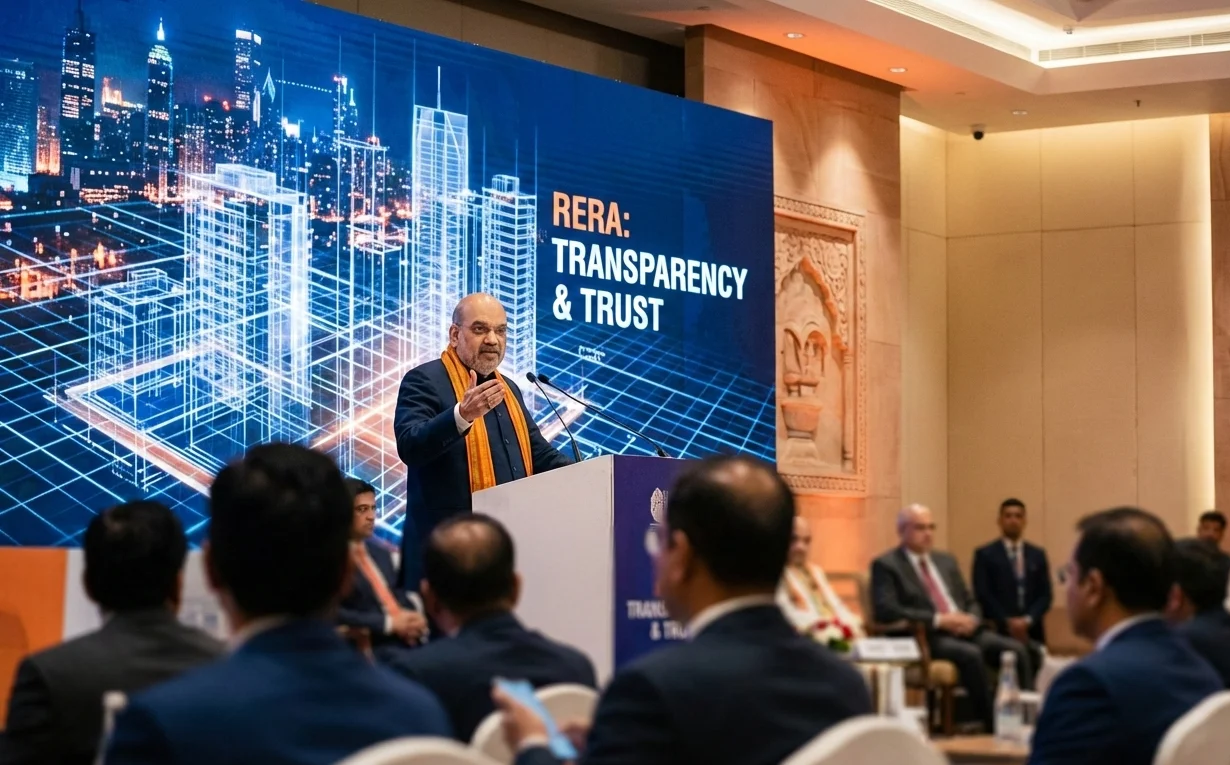
RERA Has Reshaped India’s Real Estate Sector, Says Amit Shah
India’s real estate sector has undergone a visible and meaningful transformation over the past few years. At the heart of this change stands the Real Estate (Regulation and Development) Act, commonly known as RERA. Union Home Minister Amit Shah recently reaffirmed its impact while addressing CREDAI’s National Conclave in the national capital. According to him, RERA has not only streamlined the sector but also protected the interests of millions of homebuyers across the country.
His remarks reflected a larger truth. Regulation, when implemented with clarity and intent, strengthens industries rather than slowing them down. RERA has proven exactly that.
From Chaos to Clarity: How RERA Changed the Market
Before RERA, the real estate sector struggled with inconsistency. Buyers often faced delayed possession, unclear commitments, and limited legal recourse. As a result, trust eroded steadily.
However, RERA brought a decisive shift. Developers now register projects before marketing them. Authorities monitor timelines closely. Buyers receive verified information upfront. Consequently, transparency has become the norm rather than the exception.
Amit Shah acknowledged that the industry initially expressed concern when the Act came into force. Yet, with time, discipline replaced disorder. Today, even critics agree that RERA has helped developers operate more smoothly and professionally.
Strong Protection for Homebuyers
One of RERA’s most powerful contributions lies in buyer protection. The law ensures fair transactions and improves construction quality. Developers must disclose project details clearly. They must also commit to timelines publicly.
Furthermore, grievance redressal mechanisms now work more efficiently. RERA authorities and appellate tribunals function across multiple states. Buyers no longer feel helpless when disputes arise.
Currently, over 1.55 lakh real estate projects and nearly 1.10 lakh developers stand registered under RERA. In addition, 35 states and Union Territories have adopted the framework. These numbers highlight the law’s widespread acceptance and growing maturity.
Regulation Builds Growth, Not Resistance
Amit Shah delivered a strong message during his address. Regulations do not restrict growth. Instead, they increase credibility and unlock long-term opportunities.
When businesses treat regulation as a tool rather than a hurdle, customer confidence rises. Investment flows improve. Market stability strengthens. Shah emphasized that regulation always benefits both businesses and consumers when implemented correctly.
He also clarified that his remarks did not hint at new regulatory burdens. Still, he added that even future reforms should receive acceptance in the right spirit. According to him, dialogue remains the government’s core approach while introducing policy changes.
GST Reforms Further Strengthened the Sector
Alongside RERA, GST reforms have played a crucial role in reducing construction costs. Shah highlighted that lower GST rates on key materials have helped developers manage expenses more effectively.
Affordable housing now attracts just 1% GST, down from 8%. Housing projects face 5% GST instead of 12%. Cement rates dropped from 28% to 18%. Materials like marble, granite, bricks, sand, and lime now fall under the 5% slab. Bamboo flooring also shifted to the lower rate.
As a result, developers may see an overall 5–7% reduction in costs, which can translate into better amenities and pricing flexibility for buyers.
Affordable Housing and Inclusive Growth
The government continues to prioritize housing for all. Amit Shah reiterated that real estate plays a central role in fulfilling this vision. Through organizations like CREDAI, developers can support inclusive urban growth.
He encouraged large developers to integrate affordable housing within major projects. This approach balances commercial success with social responsibility. Moreover, it ensures that urban development remains accessible to a wider population.
Industry trends already show rising demand in the mid-income and affordable segments. Well-planned projects in these categories continue to attract steady interest.
Green Buildings Must Become the New Normal
Sustainability emerged as another key theme during Shah’s address. He urged developers to incorporate green building norms into every project.
Energy-efficient designs, rainwater harvesting, water recycling, and scientific waste management should no longer remain optional. According to him, these features do not significantly increase project costs. However, they create long-term environmental and economic value.
He also praised CREDAI’s contribution toward planting 20 lakh saplings and restoring 9,000 acres of barren land. He suggested that if every developer plants ten trees per building, the sector can create a massive ecological impact.
Expert View: Sanjeev Singh, MD, SKJ Landbase

Sharing his perspective, Sanjeev Singh, Managing Director, SKJ Landbase, said:
RERA has brought a mindset shift across the real estate ecosystem. Today, transparency drives faster decisions. Buyers feel confident, and credible developers gain long-term trust. Regulation has professionalized the sector.
He also noted that informed investors now prefer RERA-compliant projects because clarity reduces risk.
The Road Ahead for Indian Real Estate
Amit Shah concluded by stressing the need for greater transparency in land markets. Cities must move away from land banking and speculative holding. Planned development should lead future growth.
RERA has already created a strong foundation. Going forward, collaboration between policymakers and developers will define the next phase of Indian real estate.
In the end, the message remains clear. Strong regulation builds stronger markets